
Umbilical Cord
DEFINITION:


- The umbilical cord or funis forms the connecting link between the fetus and the placenta through which the fetal blood flows to and from the placenta.
- It extends from the fetal umbilicus to the fetal surface of the placenta.
- The umbilical cord stump of a newborn most frequently sloughs off about the 10th day after delivery
DEVELOPMENT:
- Developed from the connective stalk or body stalk
STRUCTURES:
- Covering epithelium:Single layer of amniotic epithelium showing stratification
- Wharton’s jelly:(The extracellular matrix )Protective function to the umbilical vessels.
Blood vessels:
- Two arteries and two veins
- Umbilical vesicle attains full development in 4 week
Arteries:
- Origin:Internal iliac arteries of the fetus
- Function: Carry venous blood from the fetus to the placenta.
- The two arteries are smaller in diameter than the veins
- Derivatives:Distal parts(Urachus) form medial umbilical ligaments & proximal portions remain open as superior vesical arteries
- When fixed in their normally distended state, the umbilical arteries exhibit transverse intimal folds of Hoboken across their lumen
- Presence of single umbilical artery is often associated with fetal congenitalabnormalities
Veins:
- Right one disappears by the 4th month, leaving behind one vein which carries oxygenated blood from the placenta to the fetus.
- Function:Carry oxygenated blood towards the fetus
Derivatives:
- Ligamentum teres(from left umbilical vein)
- Ligamentum venousm(from ductus venosus )
Drainage:
- Sinus venosus(Initially)
- Hepatic sinusoids(by 5th week)
- Hepatocardiac channel through the ductus venosus(after right vein disappears)
- Remnant of the umbilical vesicle (yolk sac) and its vitelline duct:Meckel’s diverticulum(proximal part)
- Allantois
- Obliterated extraembryonic coelom
CHARACTERISTICS:
- Length:40 cm(variation of 30–100 cm)
-
At birth, the mature cord is approximately 50–60 cm in length and 12 mm in diameter.
-
A long cord is defined as more than 100 cm, and a short cord as less than 30 cm.
-
- Diameter:1.5 cm(variation of 1–2.5 cm)
- Thickness:Non uniform with false knots(Folding and tortuosity of the vessels within the cord itself creates false knots which are essentially varices).
- The exterior of umbilical cord is dull white, moist and covered by amnion through which the three umbilical vessels may be seen.
- Spiral twist from the left to right.
-
Umbilical coiling index (UCI) :The number of complete coils divided by the length of the cord in centimeters.
-
Clinically, hypocoiling (UCI 0.3 coils/cm) is related to fetal-growth restriction and intrapartum fetal acidosis and asphyxia.
-
Both have been linked to trisomies and single umbilical artery
-
- Umbilical arteries Have got well-developed muscular coat:Effective closure of the arteries soon after birth of the baby
ATTACHMENT:
Fetal attachment:
- Early period:ventral surface of the embryo close to caudal extremity
- On closure of coelom:center of the abdomen( 4th month)
Placental attachment:
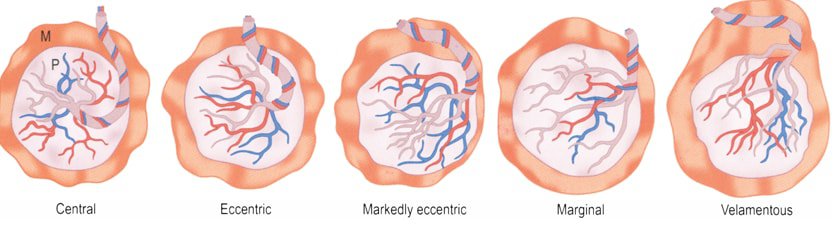
- Eccentric insertion:Between the center and the edge of the placenta
- Central
- Marginal
- Velamentous insertion:On chorion laeve
Exam Important
- Length of umbilical cord is 30-100 cms
- The folds of Hoboken are found in Umbilical cord
- Two arteries and the left vein are found in Umbilical cord
- Distal parts of the umbilical arteries form the medial umbilical ligaments, and the proximal portions remain open as the superior vesical arteries
- Umbilical vein becomes Ligamentum teres
- The umbilical cord stump of a newborn most frequently sloughs off about the 10th day after delivery
- Right vein disappear in umbilical cord
- Umbilical vein carries oxygenated blood
- Umbilical vesicle attains full development in 4 week
- Wharton’s jelly, 2 arteries and 1 vein ,Allantois are the constituents of umbilical cord.
- Median umbilical ligament is derived from Urachus
Don’t Forget to Solve all the previous Year Question asked on Umbilical Cord
Click Here to Start Quiz
Click Here to Start Quiz

