Question
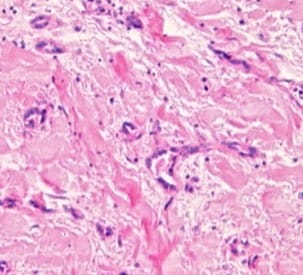
A 72-year-old male presents with an ill-defined, deep-seated mass in his right calf. It has grown appreciably in the past few months and is now roughly the size of a golf ball. A core biopsy is performed, and a representative section is shown here. The tumor cells stain positively with antibodies to CD34 and CD31. What is the most likely diagnosis?
A. Angiosarcoma.
B. Desmoid tumor.
C. Leiomyosarcoma.
D. Rhabdomyosarcoma.
Show Answer
|
Correct Answer » A
Explanation
|
|
The diagnosis in this case is angiosarcoma. Angiosarcoma is a rare tumor with a peak incidence in the 7th decade of life (though it may occur at any age). Common sites affected are the head and neck, extremities, and soft tissues. Histologically, angiosarcoma can appear relativelywell- differentiated with recognizable endothelial cells forming vascular channels, as in this case.
One thing that is usually helpful in these undifferentiated angiosarcomas (and, by the way, in any undifferentiated tumor) is immunohistochemical staining. In the case of angiosarcoma, you’d use stains for CD31 (an endothelial cell marker) and CD34 (a hematopoietic progenitor cell antigen), both of which are positive in most cases of angiosarcoma. Most other tumors are not positive for both of these markers. Some cases of leiomyosarcoma, lymphoma, and rhabdomyosarcoma may show CD34 positivity – but none of these tumors shows positivity for CD31.