

Question
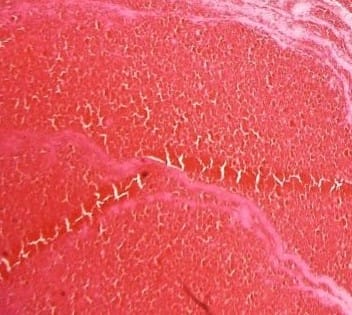
A 40-year-old woman with a history of obesity, smoking and oral contraceptive use sustains minor knee injury and avoids her regular walking activity. Three days later, she complains of lightheadedness and progressive respiratory distress over a twelve hour period, and collapses upon arrival in the emergency room. Despite extensive resuscitative efforts she dies, and an autopsy is performed and the photomicrograph is shown below.What is the pathologic process responsible for her death?

A. Congestive heart failure.
B. Mesenteric ischemia.
C. Infection.
D. Venous thrombosis.


|
Correct Answer » D Explanation |
 |

The diagnosis in this case is pulmonary thromboembolism. Pulmonary thromboemboli occur when blood in the deep veins of the legs forms a thrombus (blood clot), and then pieces of that clot break off and travel through the venous system. Once a chunk of clot starts traveling it also becomes an embolus. An embolus is just a traveling blob of stuff in a blood vessel – it can be made of fat, air bubbles, tumor, built-up cholesterol (from atherosclerosis), or as in this case, a thrombus. That’s why we call it a thromboembolus, and it is the most common type of embolus.
A key histologic feature of a thrombus are the “lines of Zahn,” which are very pretty alternating stripes of fibrin and red blood cell layers. These stripes form when the blood is flowing by and forming the thrombus layer by layer, and they tell us that the clot happened while the patient was still alive, unlike thrombi which form after death, and are a boring solid color.