Question
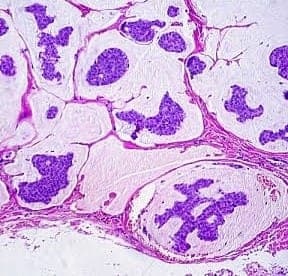
A 52-year-old woman presented to her primary care physician complaining of a new lump in the upper outer quadrant of her left breast. A mammogram demonstrated a 7 mm ovoid mass at the 2:00 position of the left breast. Targeted sonographic evaluation demonstrated a well-circumscribed, oval-shaped mass of mixed echogenicity at the 2:00 position, approximately 10 cm from the nipple. Ultrasound-guided percutaneous biopsy results were consistent with metastatic involvement of an intramammary lymph node from a mammographically occult breast carcinoma.The biopsy of the breast is shown below. The most probable diagnosis is?
A. Mucinous carcinoma of the breast.
B. Colloid carcinoma of breast.
C. Both of the above.
D. None of the above.
Show Answer
|
Correct Answer » C
Explanation
|
|
Colloid Carcinoma, sometimes called ‘mucinous‘ or mucin-producing carcinoma, is a type of invasive ductal breast cancer. The distinguishing feature of colloid carcinoma is the production of mucous. At the cellular level mucinous carcinoma appears of ‘islands‘ of malignant cells within ‘lakes‘ of mucous. Tumors for this cancer type can grow very large, and are often softer to the touch. Statistically, mucinous breast cancer accounts for approximately 3% of all breast carcinoma. It is rare in younger women and tends to effect women in their 60s. For women 75 years or older, colloid breast cancer accounts for approximately 7% of all tumors.
In the photomicrograph above, the dark purple cancer cells are surrounded by the white mucus, which stretches the ducts, a lot.