Question
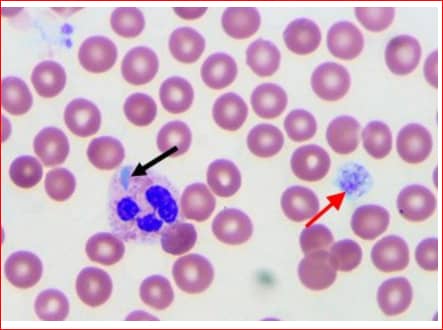
Inclusions in Peripheral cytoplasm of Cells shown is characteristic of
A. Multiple myeloma
B. May Hegglin anomaly
C. WaldenstormMacroglobulinemia
D. Lymphoma
Show Answer
|
Correct Answer » B
Explanation
|
|
Ans:B.)May Hegglin anomaly.
May–Hegglin anomaly
- Also known as Döhle leukocyte inclusions with giant platelets and macrothrombocytopenia with leukocyte inclusions, is a rare genetic disorder of the blood platelets that causes them to be abnormally large.
- It is an inherited dominant condition in which large (2 – 5 um) basophilic inclusions, resembling Döhle bodies, are present in granulocytes, including neutrophils, eosinophils, basophils, and monocytes. The inclusions are caused by accumulation of free ribosomes. A May-Hegglin body is indicated by the black arrow in the image.
- Giant platelets containing few fine granules are also characteristic of May-Hegglin anomaly. The red arrow in the image on the right points to a giant platelet, observed in the same field as a neutrophil containing a May-Hegglin body.