
Question
Identify the reaction which is shown in the picture below, produced in a special bacterial culture?
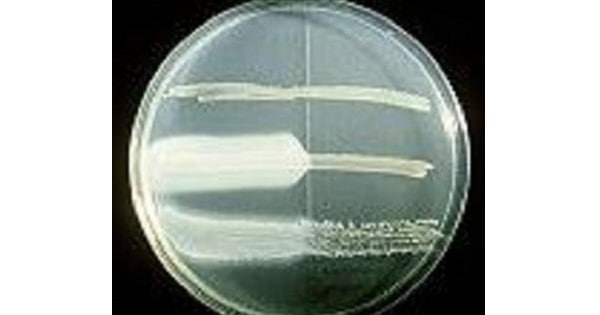
A. Nagler reaction.
B. Hemolytic reactions.
C. Gamma reaction.
D. Alpha reaction.
Show Answer

|
Correct Answer » A Explanation |
 |
Ans:A. Nagler’s reaction.
Lecithinase test or Nagler’s reaction
- It is a biochemical test used to identify organisms which liberate phospholipases (lecithinases) e.g. Clostridium perfringens,Bacillus cereus .
- Principle:Bacterial lecithinase break down this lecithin (a normal component of egg yolk) to an insoluble diglycerides resulting in an opaque halo, surrounding the colony when grown on the egg yolk agar medium.
- The alpha (α) toxin of C. perfringens has phospholipase activity and hence, helps in differentiation of C. perfringens from other Clostridium spp that also produce lecithinase (C.baratti, C.absonum, C.bifermantans, C.sordelli and C.novyi) by neutralization of lecithin c activity by an antitoxin.
- When clostridium perfringes is grown on egg yolk agar medium with the anti toxin spread on one half of the plate,after the growth of the colonies you will observe that there is a zone of opacity in the half without the antitoxin.
- There will no opacity in the other half due to neutralization of the alpha toxin.It is a specific lecithinase effect diagnostic of clostridium perfinges in clinical specimen.
- The picture above represent the opaque zone on the upper right half, around the colonies of clostridium perfringens, as a result of action of lecithinase (alpha toxin) on the lecithin of egg and THIS IS THE NAGLER’S REACTION.
- While the upper left half does not show this phenomenon because of presence of anti-alpha toxin antibodies. Clostridium sporogenes shows no opaque zone since it’s lecithenase negative.
