Question
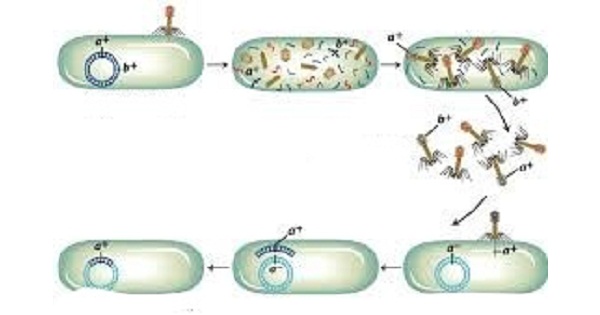
One bacterium receives a gene for restriction endonuclease from another bacterium by a process represented in the picture below. What is the likely outcome?
A. The proof-reading activity of the bacteria is increased.
B. The bacterium will die as it does not have the protective methylase enzyme.
C. The bacterium will cause digestion of host DNA on infection.
D. The mechanism of repair is excellent.
Show Answer
|
Correct Answer » B
Explanation
|
|
Ans:B. The bacterium will die as it does not have the protective methylase enzyme.
The process shown in the picture above represents transduction.
- The DNA methylase offers protection from endonucleolytic attack by the separate restriction enzyme.
- The descendants of cells that had lost the genes encoding DNA restriction endonucleases appeared unable to modify a sufficient number of recognition sites in their chromosomes to protect them from lethal attack by the remaining restriction enzymes, and consequently died.
- Hence, the fate of this bacterium which received a gene for for restriction endonuclease will be the same as given above.
Restriction endonuclease:
- Restriction endonucleases cut DNA at specific sites when the bases are not protected (modified, usually, methylation).
- Bacteria synthesize restriction enzymes as a defense against invading foreign DNAs such as phages and foreign plasmids.
- Three major types have been recognized.
- Type I enzymes are single multifunctional proteins of three subunits.
- Type II enzymes are used most widely for genetic engineering. Type II enzymes have separate endonuclease and methylase proteins.
- Type III enzymes carry out restriction and modification by two proteins with a shared polypeptide.