


Question
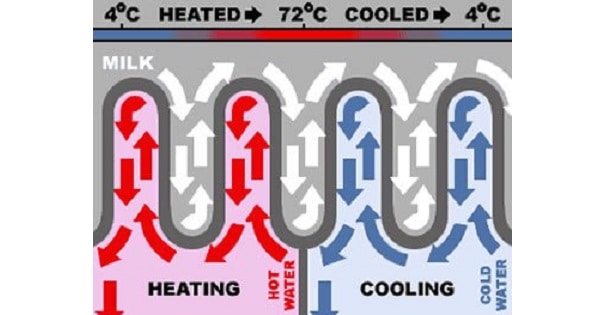
Moist heat during the process shown in the picture below kills all of the following microorganisms, EXCEPT?

A. Coxiella burnetii.
B. Brucella.
C. Salmonella.
D. Mycobacterium.
Show Answer


|
Correct Answer » A Explanation |
 |

Ans:A. Coxiella burnetii
The process shown in the picture above represents Pasteurization.
Pasteurization
- It is a process that kills microbes (mainly bacteria) in food and drink.
- It is used widely in the dairy industry and other food processing industries to achieve food preservation and food safety.
- Unlike sterilization, pasteurization is not intended to kill all microorganisms in the food.
- Instead, it aims to reduce the number of viable pathogens so they are unlikely to cause disease.Spores are not affected by pasteurization. Commercial-scale sterilization of food is not common because it adversely affects the taste and quality of the product.
- This is considered adequate for destroying almost all yeasts, molds, and common spoilage bacteria and also to ensure adequate destruction of common pathogenic, all non-sporing pathogens such as mycobacteria, brucellae and salmonellae but not Coxiella burnetii, which causes Q fever.
- Coxiella burnetii is relatively heat resistant and may survive the holder method.
- The temperature employed is either 630C for 30 minutes (the holder method) 720C for 15-20 seconds (the flash process) followed by cooling quickly to 130C or lower.
- The dairy industry routinely uses to test to determine whether products have been pasteurized: the phosphatase test (phosphatase is an enzyme naturally present in milk). If the product has been pasteurized, phosphatase will have been inactivated.