Question
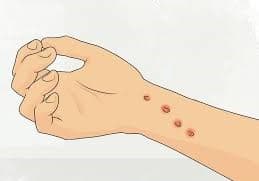
Which among the following are true about the skin condition seen after a scratch as shown in the the photograph below from a pet cat?
A. Associated with positive Frei skin test.
B. A history of an animal scratch or bite is not necessary for disease transmission.
C. Associated with a non-pathognomonic histological picture.
D. B and C
Show Answer
|
Correct Answer » D
Explanation
|
|
Ans: D. A history of an animal scratch or bite is not necessary for disease transmission and Associated with a non-pathognomonic histological picture.
The skin condition shown in the photograph above represent Cat scratch disease (CSD).
Catscratch disease (CSD)
- Also known as catscratch fever or subacute regional lymphadenitis, is a bacterial infection caused by Bartonella henselae, a gram-negative rod.
- Transmission can occur by petting alone with subsequent self-inoculation via a mucous membrane, skin break, or conjunctiva. However, infection with B henselae can be transmitted by arthropod vectors, and a history of an animal scratch or bite is not necessary for disease transmission.
Presentation:
- Red-brown nontender papules at the site of inoculation 3-10 days after the bacteria are introduced
- Tender regional lymphadenopathy.
- Systemic symptoms like Malaise/fatigue,Fever,Anorexia,Headache,Sore throat,Arthralgia .
- CNS findings are present in 5% of patients .
- Indirect fluorescence assay (IFA) testing and Enzyme-linked immunoassay (ELISA) are used to detect serum antibody to B henselae.
- Histopathological features of lymph nodes are consistent but not pathognomonic for CSD. Features include granuloma formation, stellate abscesses, and lymphocytic infiltrates. Brown-Hopp tissue Gram stain and Warthin-Starry silver staining can show clumps of small, curved, gram-negative bacilli