
Question
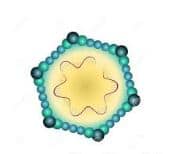
Which of the following condition is NOT caused by the virus shown in the picture below?
A. Roseola infantum.
B. Aplastic anemia in sickle cell disease.
C. Fetal hydrops.
D. Erythema infectiosum.
Show Answer

|
Correct Answer » A Explanation |
 |
Ans: A. Roseola Infantum.
The virus shown in the picture above represents Parvovirus B19.
Parvoviruses
- They are linear, non-segmented single-stranded DNA .
- They are among the smallest viruses (hence the name, from Latin parvus meaning small) .
- Although parvoviruses commonly cause disease in animals, it was only in 1975 that the first human pathogen of this family was discovered(B19)
Structure
- The viral capsid of a parvovirus is made up of two to four proteins, known as VP1-4 that form an icosahedral symmetry that is resistant to acids, bases, solvents and temperature up to 50 °C (122 degrees Fahrenheit). The capsid is also constructed from 60 protein .Parvoviruses do not have envelopes and are thus considered “naked” viruses. In addition, the shape of the virion is roughly spherical, with surface protrusions and canyons.
- Mode of transmission – Respiratory tract , blood transfusion
- Immature cells in the erythroid lineage are principal targets for human B19 parvovirus
Morbidity:
- Parvovirus B-19 causes Erythema infectiosum (fifth disease)
- Slapped cheek appearance followed by lacy reticular rash that waxes and wanes over 3 weeks
- Rarely, papular-purpuric “gloves and socks” syndrome on hands and feet
- Polyarthropathy syndrome affecting small joints of hands
- Causes aplastic crisis in patients with hemolytic disease
- Persistent anemia and pure red cell aplasia in immunocompromised
- Infection during pregnancy before 20 weeks may cause hydrops fetalis or fetal loss
Roseola infantum
- It is a common illness observed in infants and children 6 months to 4 years of age.
- Its alternative name, exanthem subitum, means “sudden” rash.
- Roseola has more than one cause: the most common is human herpesvirus type 6 and, less frequently, human herpesvirus type 7.
