Question
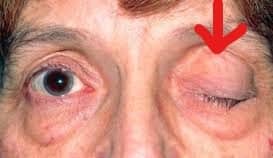
A 45 year old woman suffered from weakness in the eye muscles (as shown in the image) which later progressed to weakness in the proximal limb muscles.Weakness is typically least severe in the morning and worsens as the day progresses.
and it gets increased by exertion and alleviated by rest.Which of the following is the test of choice for the diagnosis of the autoimmune disorder which the patient is suffering from?
A. Test for Antinuclear Antibody.
B. Thyroid function test.
C. Measurement of jitter by single fibre electromyography.
D. Measurement of serum ACh-receptor binding antibodies.
Show Answer
|
Correct Answer » D
Explanation
|
|
Ans: D. Measurement of serum ACh-receptor binding antibodies.
The patient in question is suffering from Myasthenia gravis
Myasthenia gravis
- It is an autoimmune disorder of neuromuscular transmission in which antibodies form against acetylcholine nicotinic postsynaptic receptors at the neuromuscular junction of skeletal muscles.
- Women are more often affected than men.
- The usual initial complaint is a specific muscle weakness rather than generalized weakness
- Extraocular muscle weakness or ptosis is present initially in 50% of patients and occurs during the course of illness in 90%.
- Weakness tends to spread from the ocular to facial to bulbar muscles and then to truncal and limb muscles.
- Limb weakness may be more severe proximally than distally.
- Weakness is typically least severe in the morning and worsens as the day progresses.
- Weakness is increased by exertion and alleviated by rest.
- The anti–acetylcholine receptor (AChR) antibody (Ab) test is reliable for diagnosing autoimmune myasthenia gravis
Therapy for MG includes the following:
- Anticholinesterase (AchE) inhibitors
- Immunomodulating agents
- Intravenous immune globulin (IVIg)
- Plasmapheresis
- Thymectomy
- One test is for antibodies against the acetylcholine receptor;[13] the test has a reasonable sensitivity of 80–96%
- In single-fiber electromyography, which is considered to be the most sensitive (although not the most specific) test for MG