

Question
A 49 year old female presents with a complain of a red painful right eye, with blurry vision along with photophobia for the past five days. Her symptoms have gotten worse over the past 5 days since she started gardening; she thinks a plant branch scratched her right eye..She has no history of contact lens wearing and no underlying medical problems.The condition of her eye is shown in the image.Hypopyon in this condition contains

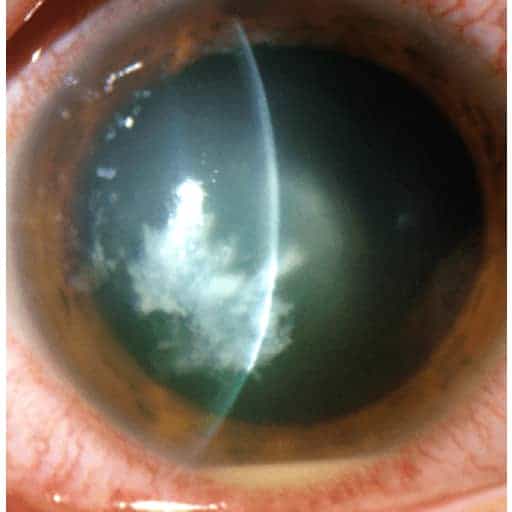
A. Fungal filaments
B. Fungal spores
C. Purulent material
D. Sterile material


|
Correct Answer » A Explanation |
 |

Ans:A. Fungal filaments
The patient is suffering from Fungal Corneal Ulcer
Fungal keratitis /Fungal Corneal Ulcer
- Inflammation of the cornea from infection by a fungal organism.
- Cause:Aspergillus species is the most common isolate in fungal keratitis worldwide,followed by Candida species.
- The precipitating event for fungal keratitis is trauma with a vegetable / organic matter. A thorn injury, or in agriculture workers, trauma with a wheat plant while cutting the harvest is typical.
- Pathophysiology:The fungus grows slowly in the cornea and proliferates to involve the anterior and posterior stromal layers. The fungus can break through the descemet’s membrane and pass into the anterior chamber.
- Infection with fungal keratitis (FK) can be more virulent and damaging compared to that of a bacterial origin. Fungal keratitis was shown to be more likely to perforate the cornea than bacterial keratitis
- Symptoms:
- Blurred vision, a red and painful eye that does not improve when contact lenses are removed, or on antibiotic treatment, increased sensitivity to light (photophobia), and excessive tearing or discharge. The symptoms are markedly less as compared to a similar bacterial ulcer.
- Signsthat are specific to fungal keratitis include :
- An infiltrate with feathery margins, elevated edges, rough texture, gray-brown pigmentation, satellite lesions, hypopyon(unsterile and fixed), and endothelial plaque.
-
Hypopyon in fungal ulcer is not sterile as in bacterial corneal ulcer because the fungi penetrate in the anterior chamber without perforation.
Hypopyon in fungal ulcer is fixed and does not show positional variation as in bacterial corneal ulcer as the fungal filaments adhere to the walls of anterior chamber.