Question
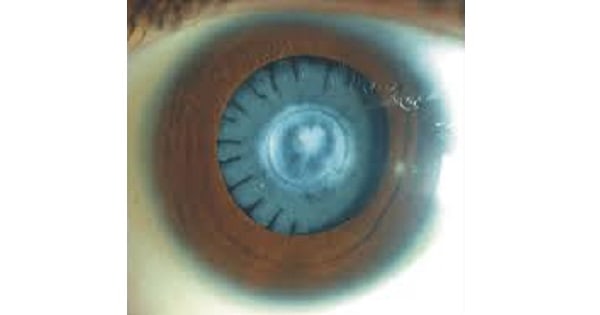
Ocular examination of a man presenting with Neurological and Liver Dysfunction shows the presence of condition as shown in the picture below. What is the most probable diagnosis of the condition which the patient is suffering from?
A. Hemochromatosis
B. SLE.
C. Wilson’s Disease
D. Sarcoidosis.
Show Answer
|
Correct Answer » C
Explanation
|
|
Ans:C. Wilson’s Disease.
The condition as shown in the picture above represents Sunflower cataract and Kayser-Fleischer ring
Wilson’s disease
- It is an autosomal-recessive disorder of copper metabolism due to mutation of the ATP7B gene in chromosome 13 (13q14.3).
- The main sites of copper accumulation are the liver and the brain, and consequently liver disease and neuropsychiatric symptoms are the main features that lead to diagnosis.
Eye manifestations:
- Sunflower cataract: occurs due to copper deposition in the anterior capsule. Posterior capsule deposition appears to be uniform.
- It is brilliant golden green in colour and arranged like the pearls of a sunflower. The radiating folds are thought to be due to the impression of the posterior surface of the iris on the anterior lens capsule.
- It has been reported to occur in other conditions like intraocular copper bodies (chalcosis) and primary biliary cirrhosis, and have been shown to regress either partially or completely following penicillamine therapy.
- Kayser-Fleischer ring: It is a golden brown ring which occurs due to deposition of copper under peripheral parts of the Descemet’s membrane of the cornea.
- Free copper loosely bound to albumin enters the aqueous humor and then enters the descemet membrane.
- The peripheral deposition is attributed to the direction of the aqueous humor.