
Question
ldentify the Clinical test shown in the Photograph
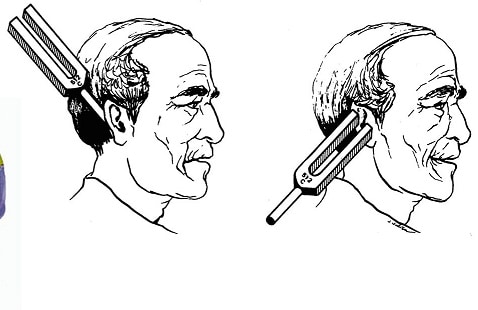
A. Rinne’s test
B. Weber’s test
C. Modififed Schwabach’s test
D. Gelle’s test
Show Answer

|
Correct Answer » A Explanation |
 |
Ans: A. Rinne’s Test
RINNE’S TEST
- It is a type of Tuning fork test
- It compares perception of sounds transmitted by air conduction to those transmitted by bone conduction through the mastoid.
INTERPRETATIONS:
- (AC= Air Conduction and BC= Bone Conduction)
- Normal:AC > BC (Rinne’s Positive)
- Conductive Hearing Loss:BC > AC (Rinne’s Negative).
- Sensorineural Hearing Loss:AC>BC.
The procedure is done by all three tuning forks. (256 Hz, 512 Hz, 1024 Hz).For routine clinical practice, tuning fork of 512 Hz is ideal.
- Negative Rinne’s test of 256 Tuning Fork Frquency suggests Mild Conductive hearing loss of 10-15 dB.
- Negative Rinne’s test of 512 Tuning Fork Frquency suggests Moderate Conductive hearing loss of 25 dB.
- Negative Rinne’s test of 1024 Tuning Fork Frquency suggests Severe Conductive hearing loss of 20-35 dB.
- A Rinne test should always be accompanied by a Weber test to also detect sensorineural hearing loss and thus confirm the nature of hearing loss.
False Negative Rinne’s Test:
- When a patient has unilateral sensori-neural deafness in the test ear, the bone conduction stimulus may be perceived by the opposite ear. Hence it can be interpreted as Rinne’s Negative.
- In such cases,Weber’s test will be lateralised to the normal ear thus confirming false negative Rinne’s result. The above can also be avoided by giving a masking sound to the non-test ear.
