
Question
Identify the test shown in the Photograph
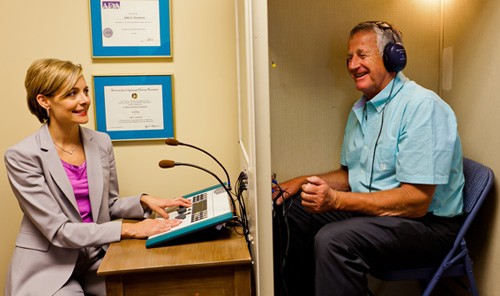
A. Electrocochleography.
B. Otoacoustic Emission.
C. BERA test.
D. Pure tone audiometry.
Show Answer

|
Correct Answer » D Explanation |
 |
Ans: D. Pure Tone Audiometry.
TYPES OF AUDIOMETRY
- Subjective Audiometry
- Pure Tone Audiometry,Speech audiometry,Bekesy Audiometry
- Objective Audiometry
- Immittance Audiometry,BERA,Electrocochleography,Otoacoustic Emission Audiometry.
PURE TONE AUDIOMETRY
- Pure tone audiometry is a subjective test used in the assessment of hearing
- The test can provide both bone and air conduction threshold.
- The frequency range tested includes 250Hz to 8kHz.
- There is also high frequency Pure Tone Audiometry covering the frequency range above 8000hz to 16,000hz,specifically for ototoxicity monitoring,
- The threshold of lower limit of normal is considered to be 20dB.
- Pure-tone average (PTA) is the average of hearing sensitivity at 500, 1000, and 2000 Hz.
USES OF PURE TONE AUDIOMETRY
- The usual primary purpose of pure-tone tests is to determine the type, degree, and configuration of hearing loss.
- Essential to prescribe a hearing aid.
- To find the degree of handicap for medicolegal purposes.
- To predict speech reception threshold.
PURE TONE AUDIOGRAM TYPICAL OF AUDITORY DISORDERS
- Presbyacusis: bilateral and symmetric sensorineural hearing loss. Usually, the higher frequencies are most severely affected.
- Otitis Media: flat or up-sloping conductive hearing loss. Word recognition usually is excellent
- Noise-induced hearing loss: greatest in the 4000- to 6000-Hz region.
- Otosclerosis :slowly progressive conductive or mixed hearing loss,Dip at 2000 Hz-Carhart’s Notch.
