

Question
Identify the maneuver shown in photograph below ?

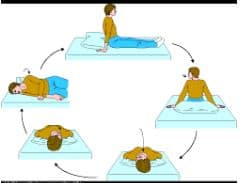
A. Epleys maneuver.
B. Brandt-Daroff exercises
C. Semont maneuver.
D. None of the above.
Show Answer


|
Correct Answer » A Explanation |
 |

Ans : A. Epleys maneuver.
Benign Paroxysmal Positional Vertigo
- Vertigo when the head is placed in a certain critical position
- No hearing loss or other neurological symptoms.
Etiopathology:
Canalithiasis :
- Within the labyrinth of the inner ear lie collections of calcium crystals known as otoconia or otoliths.
- In patients with BPPV, the otoconia are dislodged from their usual position within the utricle, and migrate over time into one of the semicircular canals (the posterior canal is most commonly affected due to its anatomical position).
- When the head is reoriented relative to gravity, the gravity-dependent movement of the otoconial debris within the affected semicircular canal causes abnormal (pathological) endolymph fluid displacement and a resultant sensation of vertigo.
Cupulolithiasis :
- In rare cases, the crystals themselves can adhere to a semicircular canal cupula, rendering it heavier than the surrounding endolymph. Upon reorientation of the head relative to gravity, the cupula is weighted down by the dense particles, thereby inducing an immediate and sustained excitation of semicircular canal afferent nerves.
Diagnosis:
- The Dix-Hallpike test is a common test to determine whether the posterior semicircular canal is involved.It involves a reorientation of the head to align the posterior semicircular canal with the direction of gravity. This test will reproduce vertigo and nystagmus characteristic of posterior canal BPPV.
Treatment:
Repositioning maneuvres:
- The Epley maneuver is used to treat benign paroxysmal positional vertigo (BPPV) of the posterior or anterior canals.It works by allowing free floating particles from the affected semicircular canal to be relocated, using gravity, back into the utricle.
- Other: Semont maneuver, and to a lesser degree Brandt-Daroff exercises