
Question
The ring as marked by arrows seen at the periphery of the ear drum in a patient represents ?
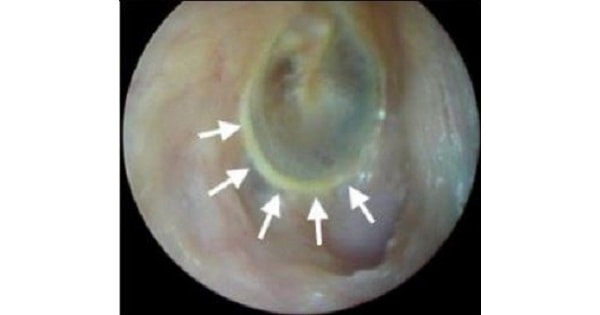
A. Tympanic annulus.
B. Tympanic fibres.
C. Tympanic sulcus.
D. None of the above.
Show Answer

|
Correct Answer » A Explanation |
 |
Ans:A. Tympanic annulus
Tympanic membrane
Structure:
- Outer epithelial/cutaneous layer: stratified squamous epithelium .
- Middle fibrous layer: thin/absent in pars flaccida; contains 3 types of fibers – radial, circular and parabolic.
- Inner mucosal layer
Components
- Anterior and posterior malleolar fold: Converges to the lateral process of malleus from 2 ends of the tympanic notch of Rivinus
- Pars flacidda/Sharpnell membrane/Rivinus membrane: Part of relatively lax membrane lying above the malleolar folds; lack middle fibrous layer
- Pars tensa: Relatively taut and forms the remaining part of the tympanic membrane; contain all 3 layers
- Annulus tympanicus: It is the thickened edges of the ear drum(pars tensa) which forms fibrocartilaginous rings and reside in tympanic sulcus.
- Umbo: Center of the tympanic membrane which divides it into 4 quadrants and the point of attachment for the handle of malleus
- Tympanic notch of Rivinus/Rivinus incisure: Notch (deficient area) in the superior part of fibrocartilaginous tympanic ring bridged by pars flaccida.
- Cone of light/Light reflex: In the antero-inferior quandrant, below and anterior to the handle of malleus
Ossicles seen :
- The handle of the malleus is seen extending downwards and backwards, ending at the apex of the triangular “cone of reflected light.”
- The lateral process of malleus through which passes anterior and posterior malleolar folds
- The long process of the incus and its articulation with the head of the stapes may frequently be seen through the postero-superior quadrant of a thin tympanic membrane.
