
Question
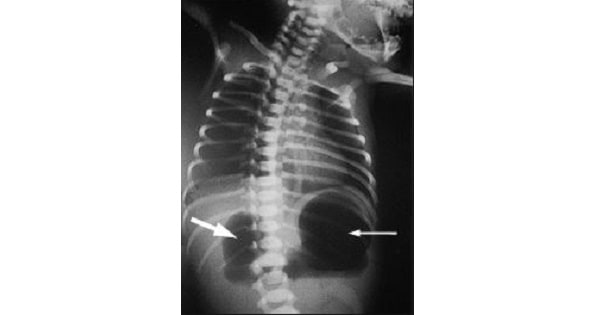
A newborn had a bilious vomiting after 6 hours of birth. X-ray of the abdomen shows as represented in the picture below. This is a feature of ?
A. Pyloric stenosis.
B. Duodenal atresia.
C. Ileal atresia.
D. Esophageal atresia.
Show Answer

|
Correct Answer » B Explanation |
 |
Ans:B. Duodenal atresia
“Double bubble” sign is seen in the image .
-Thin arrow: dialated stomach
-Thick arrow: dialated proximal duodenum
Double bubble sign
- It is seen in infants and represents dilatation of the proximal duodenum and stomach.
- It is seen in both radiographs and ultrasound, and can be identified antenatally .
Causes include :
- congenital obstruction
- duodenal web
- duodenal atresia
- duodenal stenosis
- annular pancreas
midgut volvulus
external compression of the dudenum
- choledochal cyst
- mesenteric duplication cyst
- intramural duodenal haematoma
- preduodenal portal vein
- retroperitoneal tumour
Duodenal Atresia
- It is thought to represent a failure of recanalisation of the bowel lumen that is a solid tube early in fetal life (~11-12 weeks).
- Approximately 20–40 percent of all infants with duodenal atresia have Down syndrome.
- During pregnancy, duodenal atresia is associated with increased amniotic fluid in the uterus, which is called polyhydramnios.
- After birth, duodenal atresia may cause abdominal distension, especially of the upper abdomen.
- Bilious vomiting commonly occurs within the first day of life.
- The diagnosis of duodenal atresia is usually confirmed by radiography.
- An X-ray of the abdomen shows two large air filled spaces, the so-called “double bubble” sign. The air is trapped in the stomach and proximal duodenum, which are separated by the pyloric sphincter, creating the appearance of two bubbles visible on x-ray.
Treatment
- Early treatment includes removing fluids from the stomach via a nasogastric tube, and providing fluids intravenously. The definitive treatment for duodenal atresia is surgery (duodenoduodenostomy), which may be performed openly or laparoscopically.
