
Question
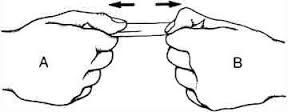
A patient presented with weakness in flexion of the hand at the wrist, loss of flexion of the 4th and 5th digits.The following clinical test was done as shown in the image.Identify the nerve being affected .
A. Median nerve.
B. Radial nerve.
C. Axillary nerve.
D. Ulnar nerve.
Show Answer

|
Correct Answer » D Explanation |
 |
Ans: D. Ulnar Nerve.
Injury to the Ulnar nerve
At the elbow
- Common mechanisms of injury:
- Cubital tunnel syndrome, fracture of the medial epicondyle (causing cubitus valgus with tardy ulnar nerve palsy)
- Motor deficit:
- Weakness in flexion of the hand at the wrist, loss of flexion of the 4th and 5th digits, loss of ability to cross the digits of the hand.
- Presence of a claw hand deformity when the hand is at rest, due to hyperextension of the 4th and 5th digits at the metacarpophalangeal joints, and flexion at the interphalangeal joints.
- Weakness of adduction of the thumb, which may be assessed by the presence of Froment’s sign.
- Sensory deficit:
- Loss of sensation or paresthesiae in ulnar half of the palm and dorsum of hand, and the medial 1½ digits on both palmar and dorsal aspects of the hand
At the wrist
- Common mechanism:
- penetrating wounds, Guyon canal cyst
- Motor deficit:
- Loss of flexion of 4th and 5th digits, loss of ability to cross the digits of the hand.
- Presence of a claw hand deformity when the hand is at rest, due to hyperextension of the 4th and 5th digits at the metacarpophalangeal joints, and flexion at the interphalangeal joints.
- The claw hand deformity is more prominent with injury at the wrist as opposed to a lesion higher up in the arm, for instance, at the elbow, as the ulnar half of the flexor digitorum profundus is not affected. This pulls the distal interphalangeal joints of the 4th and 5th digit into a more flexed position, producing a more deformed ‘claw’. This is known as the ulnar paradox.
- Weakness of adduction of the thumb, which may be assessed by the presence of Froment’s sign.
- Sensory deficit:
- Loss of sensation or paresthesiae in ulnar half of the palm, and the medial 1½ digits on the palmar aspect of the hand, with dorsal sparing. The dorsal aspect of the hand is unaffected as the posterior cutaneous branch of the ulnar nerve is given off higher up in the forearm and does not reach the wrist.
Clinical Tests:
-
- Positive Card Test:Weakness of Palmar interossei
- There is weakness of finger adduction,so patient is unable to hord card firmly between fingers.
- Positive EGAWA’S test:
- due to weakness of Dorsal Interossei,side to side movements of middle finger is weak.
- Positive Card Test:Weakness of Palmar interossei
Positive Book Test/Froment Sign:Weakness of adduction of the thumb due to palsy of Adductor Pollicis.
- To perform the test, a patient is asked to hold an object, usually a flat object such as a piece of paper, between their thumb and index finger (pinch grip). The examiner then attempts to pull the object out of the subject’s hands.
- A normal individual will be able to maintain a hold on the object without difficulty.
- However, with ulnar nerve palsy, the patient will experience difficulty maintaining a hold and will compensate by flexing flexor pollicis longus of the thumb to maintain grip pressure causing a pinching effect.
- Clinically, this compensation manifests as flexion of the IP joint of the thumb (rather than adduction, as would occur with correct use of the adductor pollicis).
