
Question
A patient presented with the following condition as shown in the image.He has a long term history of sleeping in a chair after taking Alcohol.Which nerve is injured?
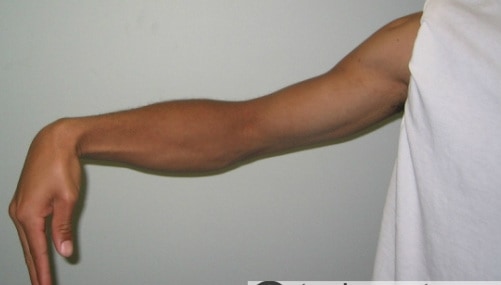
A. Radial Nerve
B. Median Nerve
C. Ulnar Nerve
D. Axillary Nerve
Show Answer

|
Correct Answer » A Explanation |
 |
Ans: A. Radial Nerve.
The patient is suffering from Saturday night Palsy
Radial Nerve
- It originates from the brachial plexus, carrying fibers from the ventral roots of spinal nerves C5, C6, C7, C8 & T1.
- The radial nerve and its branches provide motor innervation to the dorsal arm muscles (the triceps brachii and the anconeus) and the extrinsic extensors of the wrists and hands; it also provides cutaneous sensory innervation to most of the back of the hand, except for the back of the little finger and adjacent half of the ring finger (which are innervated by the ulnar nerve).
- The radial nerve divides into a deep branch, which becomes the posterior interosseous nerve, and a superficial branch, which goes on to innervate the dorsum (back) of the hand.
Radial Nerve injury
Injury to the radial nerve at different levels causes different syndromes with varying motor and sensory deficits.
At the axilla
- Common mechanisms of injury: Saturday night palsy(placing one’s arm over another chair, with the resultant pressure causing injury to the radial nerve.), crutch palsy
- Motor deficit:
- Loss of extension of forearm, weakness of supination, and loss of extension of hand and fingers.
- Presence of wrist drop, due to inability to extend the hand and fingers.
- Sensory deficit:
- Loss of sensation in lateral arm, posterior forearm, the radial half of dorsum of hand, and dorsal aspect of radial 3 1⁄2 digits, excluding their nail beds.
At mid-arm
- Common mechanism of injury: Mid-shaft humeral fracture
- Motor deficit:
- Weakness of supination, and loss of extension of hand and fingers.
- Presence of wrist drop, due to inability to extend the hand and fingers.
- Sensory deficit:
- Loss of sensation in posterior forearm, the radial half of dorsum of hand, and dorsal aspect of radial 3 1⁄2 digits, excluding their nail beds.
Just below the elbow
- Common mechanism of injury: Neck of radius fracture, elbow dislocation or fracture, tight cast, rheumatoid nodules, injections due to tennis elbow, injuring the deep branch of the radial nerve that pierces the radial head, causing posterior interosseous nerve syndrome
- Motor deficit:
- Weakness in extension of hand and loss of extension of fingers.
- Presence of finger drop, and partial wrist drop, since the extensor carpi radialis longus and brachioradialis muscles are working.
- Sensory deficit:
- None, as sensation is supplied by the superficial radial nerve
Within the distal forearm:
- Common mechanism of injury: Wartenberg’s syndrome, (not to be confused with Wartenberg’s sign), due to nerve entrapment beneath the tendinous insertion of brachioradialis, tight jewellery, and watch bands.
- Motor deficit: None
- Sensory deficit: Numbness and tingling in radial half of dorsum of hand, and dorsal aspect of radial 3 1⁄2 digits, excluding their nail beds.
- In Wartenberg’s syndrome, there is significant radial wrist pain, and close resemblance to symptoms in de Quervain’s tenosynovitis. Finkelstein’s test may be positive
