

Question
A middle aged woman with a history of wearing high heel shoes, presented with a complain of pain in the foot while walking.On examination of the foot,the following condition is seen.Doctor advised to use insoles.What would be the most probable diagnosis?

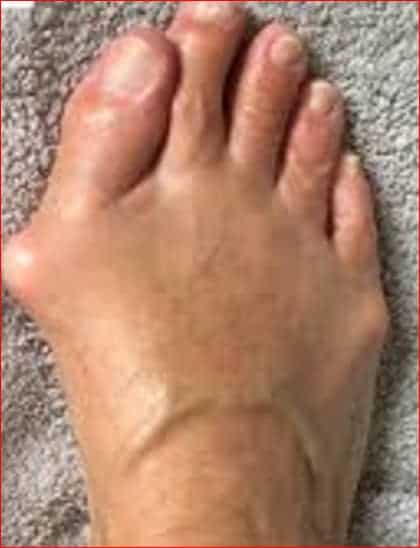


A. Hallux varus
B. Hallux valgus
C. Gout
D. Calcaneal spur
Show Answer


|
Correct Answer » B Explanation |
 |

Ans: B. Hallux valgus
Hallux valgus ( bunion or ganglion.)
- Most common deformity of the forefoot and the toes.
- A bunion is a deformity of the joint connecting the big toe to the foot. It is characterized by medial deviation of the first metatarsal bone and lateral deviation of the hallux (big toe).
Causes :
- Acquired deformity, e.g. from high heeled shoes.
- Congenital predisposition (common in some families).
- Women are affected more often due to the weaker connective tissue.
Splayfoot (drop in the front arch of the foot (transverse arch)) encourage hallux valgus.
- An accident can be the cause for hallux valgus.
- Arthritic changes to the joints can be the cause for hallux valgus.
- Some neurological disorders can lead to hallux valgus.
Pathophysiology:
- The bump itself is partly due to the swollen bursal sac or an osseous (bony) anomaly on the metatarsophalangeal joint.
- The larger part of the bump is a normal part of the head of the first metatarsal bone that has tilted sideways to stick out at its distal (far) end.
Symptoms:
- Irritated skin around the bunion, pain when walking, joint redness and pain, and possible shift of the big toe toward the other toes.
- Blisters may form more easily around the site of the bunion as well.Difficulty in shoe finding.
- Arthritis of the big toe joint, diminished and/or altered range of motion, and discomfort with pressure applied to the bump or with motion of the joint.
Diagnosis:
- X-ray showing measurements of HVA and IMA angles of hallux valgus.
- The hallux valgus angle (HVA) is the angle between the longitudinal axes of the proximal phalanx and the first metatarsal bone of the big toe.
- It is considered abnormal if greater than 15-18°.
The HVA angle can also be used to grade the severity of hallux valgus as:
- Mild: 15–20°
- Moderate: 21–39°
- Severe: ≥ 40°
- The intermetatarsal angle (IMA) is the angle between the longitudinal axes of the first and second metatarsal bones, and is normally less than 9°.
The IMA angle can also grade the severity of hallux valgus as:
- Mild: 9–11°
- Moderate: 12–17°
- Severe: ≥ 18°
Treatment:
- Orthopaedic technique for hallux valgus
- Toe spreader
- Toe cushion
- Insoles with support
- Ball roller
- Orthoses (hallux splints)
Surgery:
- removing the abnormal bony enlargement of the first metatarsal,
- realigning the first metatarsal bone relative to the adjacent metatarsal bone,
- straightening the great toe relative to the first metatarsal and adjacent toes,
- realigning the cartilagenous surfaces of the great toe joint,
- addressing arthritic changes associated with the great toe joint,
- repositioning the sesamoid bones beneath the first metatarsal bone,
- shortening, lengthening, raising, or lowering the first metatarsal bone