
Question
A 3 year old girl presented with Tredenlenburg gait.Galeazzi’s sign and Ortolani test was positive.She undergone following osteotomy surgery.Identify this Surgical procedure.
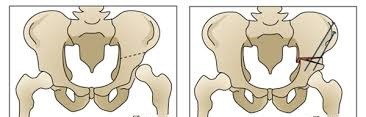
A. Pamberton osteotomy
B. Salter osteotomy
C. Steel’s osteotomy
D. Dega osteotomy

|
Correct Answer » B Explanation |
 |
Ans:B. Salter Osteotomy
Patient is suffering from Congenital dislocation of the hip
Congenital dislocation of hip /Developmental dysplasia of hip
- The femoral head is not stable within the socket (which is also known as the acetabulum).
- Girls are affected six times as often as boys. In one third of cases, bilateral affection occurs.
- The early sign of congenital hip dislocation is when a person is able to hear “clicking” sounds when the legs are moved apart from one another.
Screening:
- Ortolani maneuver :the examiner put the newborn baby in a position in which the contralateral hip is held still while the thigh of the hip being tested is abducted and gently pulled anteriorly. If a “clunk” is heard (the sound of the femoral head moving over the acetabulum), the joint is normal, but absence of the “clunk” sound indicates that the acetabulum is not fully developed.
- Barlow maneuver. It is done by adducting the hip while pushing the thigh posteriorly. If the hip goes out of the socket it means it is dislocated, and the newborn has a congenital hip dislocation.
The clinical findings in older child are :-
- Limitation of abduction and external rotation.
- Limb is in adduction, internal rotation & flexion.
- Asymmetrical thigh fold
- Higher buttock fold on the affected side.
- Galeazzi’s sign : The level of the knees are compared in a child lying with hip flexed to 70° and knees flexed. There is a lowering of the knee on the affected side
- Ortolani’s test may be positive.
- Trendelenbug’s test is positive : This test is performed in an older child. The child is asked to stand on the affected side. The opposite ASIS (that of the normal side) dips down .
- The limb is short and slightly externally rotated. There is lordosis of the lumbar spine.
- Telescopy positive : In a case of a dislocated hip, it will be possible to produce an up and down piston- like movement at the hip. This can be appreciated by feeling the movement of the greater trochanter under the fingers.
- A child with unilateral dislocation exhibits a typical gait in which the body lurches to the affected side as the child bears weight on it (Trendelenburg’s gait).
- In a child with bilateral dislocation, there is alternate lurching on both side (waddling gait).
- There is compensatory genu valgum as patient tries to keep the foot out (to compensate adduction at hip).
Management
- 0-6 months
– Pavlik harness.
It is a soft harness-like device that has straps that hold the legs apart and bent at the knee, in an attempt to keep the femur (ball) in the acetabulum (socket) in the correct position.
- 6 Months – 2 years, failed Pavlik
– Closed reduction ± tenotomies, hip spica cast 3 months - 2-3 years, failed closed reduction
– Open reduction - 3+ years
– Open reduction ± femoral osteotomy ± pelvic
osteotomy.
Pelvic osteotomies
They are usually performed between ages 3-8 years
Four general types of osteotomies
Single innominate (Salter)
- Performed when the socket doesn’t sit on top of the ball at the top of the femoral head.
- The pelvic bone is cut and the entire socket is rotated into a better position on top of the femoral head after the hip is reduced into the socket.
- Requires concentrically reduced hip
- Open reduction at same time possible
- Iliopsoas and adductor tenotomies often required
- Covers antero-lateral acetabular deficiency
- Up to 15 Degree of acetabular index corrected
– Acetabuloplasty (Pemberton)
- Requires reduced hip
- Decreases acetabular volume (small head)
- Remodeling of acetabulum required
- Corrects >15 Degree AI
- Reduces antero-lateral acetabular defects
– Triple innominate (Steel)
- Age – Skeletally mature
- Requires congruent hip joint
- Divides ilium, ischium and superior ramus
- Acetabulum rotationally free
- Indicated when other osteotomies not possible
- Rotates to cover any acetabular defect
– Shelf /Chiari
- Age – skeletally mature
- Salvage operation only
