
Question
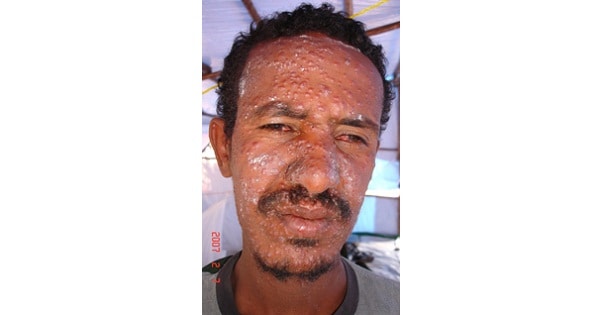
A 40 year old male patient ,residing in Bihar,presented with the following skin lesions as shown in the image.He had a history of a disease with hepatosplenomegaly 2 years before.What is the most probable diagnosis?
A. Tuberculoid Leprosy
B. Lepromatous Leprosy
C. Post Kala Azar Dermal Leishmaniasis
D. Histoid Hansen’s Disease
Show Answer

|
Correct Answer » C Explanation |
 |
Ans:C. Post Kala Azar Dermal Leishmaniasis.
Leishmaniasis
- It is a disease caused by an intracellular protozoan parasite (genus Leishmania) transmitted by the bite of a female phlebotomine sandfly.
- Types:
- Cutaneous leishmaniasis :
- Localized cutaneous leishmaniasis: Crusted papules or ulcers on exposed skin.
- Diffuse (disseminated) cutaneous leishmaniasis: Multiple, widespread nontender, nonulcerating cutaneous papules and nodules.
- Leishmaniasis recidivans: Presents as a recurrence of lesions at the site of apparently healed disease years after the original infection, typically on the face and often involving the cheek; (lesions in the center or periphery of an old healed leishmaniasis scar).
- Post–kala-azar dermal leishmaniasis: It is mainly seen in Sudan and India where it follows treated VL(Visceral Leishmaniasis) in 50% and 5-10% of cases, respectively.
- Thus, it is largely restricted to areas where Leishmania donovani is the causative parasite. The interval at which PKDL follows VL is 0-6 months in Sudan and 2-3 years in India.
- Kala azar is endemic in eastern States of India namely Bihar, Jharkhand, Uttar Pradesh and West Bengal
- Cutaneous lesions ranges from hypopigmented macules to erythematous papules and from nodules to plaques.
- Nerve involvement is common in African variety but rare in Indian subcontinent.
- Mucocutaneous leishmaniasis consists of the relentless destruction of the oropharynx and nose, resulting in extensive midfacial destruction.
- Visceral and viscerotropic leishmaniasis include the following features:
- Visceral leishmaniasis (kala-azar): Potentially lethal widespread systemic disease characterized by darkening of the skin as well as the pentad of fever, weight loss, hepatosplenomegaly, pancytopenia, and hypergammaglobulinemia
- Viscerotropic leishmaniasis: Nonspecific abdominal tenderness; fever, rigors, fatigue, malaise, nonproductive cough, intermittent diarrhea, headache, arthralgias, myalgias, nausea, adenopathy, transient hepatosplenomegaly.
- Management
- Sodium stibogluconate ,Liposomal amphotericin B,Oral miltefosine,Intramuscular pentamidine,Orally administered ketoconazole, itraconazole, fluconazole, allopurinol, and dapsone,Topical paromomycin
