

Question
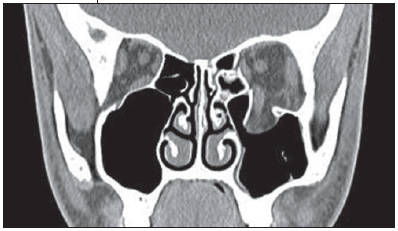
A patient presented with blunt trauma over face. Coronal CT scan is shown.All the following symptoms can occur because of this condition except:

A. Enophthalmos
B. Hypesthesia in distribution of infraorbital nerve
C. Blindness
D. Enophthalmos
Show Answer


|
Correct Answer » C Explanation |
 |

Ans:C. Blindness
Fracture Orbital Blow Out is seen in the CT scan.Herniation of fat in the maxillary sinus is seen.
Blow out fracture of Orbit
- When an external force is applied to the globe, intraorbital pressure increases to the point that one or more of the thin-walled bones of the orbit “blow-out” or fracture.
- The most common site for a blowout fracture to occur is the posteromedial aspect of the orbital floor, medial to the infraorbital neurovascular bundle where the maxillary bone is very thin.
Clinical features:
| Enophthalmos | Recession of the eyeball within the orbit |
| Diplopia: Double vision | Especially on upward gaze
Due to inferior rectus entrapment
Forced Duction test is positive confirming the presence of muscle restriction
|
| Hypesthesia: Reduced sense of touch or sensation | Due to injury of infraorbital nerve
Usually have numbness of the gingiva and of the skin of the midface
|
Investigation:
- Radiograph (Waters view) may see a soft tissue mass on the superior margin of the maxillary sinus, representing the herniated periorbital tissues into the sinus.
- Hanging drop or tear drop sign: hanging opacity of superior maxillary antrum.
- Computed tomography is the gold standard. Coronals provide best view. Extraocular muscle rounding and herniation of fat into maxillary sinus can be clearly viewed.
Management:
- Surgery (optimal time is after 10-14 days of injury) is indicated in
- Persistent diplopia
-
- Enopthalmos > 3 mm
-
- Incarceration of tissue in the fracture with resulting globe retraction and increased applanation tension on attempted upward gaze
-
- Fracture with large herniation of tissue into the antrum