

Question
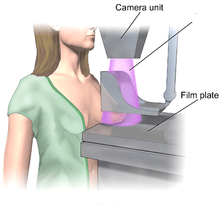
True about condition shown in the image is all except following:

A. Procuce white and black image
B. Results expressed as BIRADS
C. Recommended for young females
D. Low energy X-rays
Show Answer


|
Correct Answer » C Explanation |
 |

Ans:C. Recommended for young females.
The procedure shown in the image is Mammography.
Mammography
- It is X-ray imaging of breasts to detect tumors or other abnormalities.
- It is of 2 types –
- i) Screening mammography is used to detect breast changes in women who have no signs or symptoms of any breast abnormality. The goal is to detect cancer before any clinical signs are noticeable.
- Screening mammography every year for women, beginning at age 40.
- This usually requires at least 2 mammograms from different angles of each breast – a) the cranio-caudal (cc) view and b) the mediolateral-oblique (MLO) view.
- ii) Diagnostic mammography is used to investigate suspicious breast changes such as a breast lump, breast pain, an unusual skin change, nipple discharge. It is also used to evaluate abnormal findings on a screening mammogram.
- i) Screening mammography is used to detect breast changes in women who have no signs or symptoms of any breast abnormality. The goal is to detect cancer before any clinical signs are noticeable.
- It is of 2 types –
- Two target materials used for mammography are molybdenum (Z 42) and rhodium (Z 45), the former being the most common.
- Low energy X rays are used in Mammography.
- Different parts of the body absorb the x-rays in varying degrees. Dense bone absorbs much of the radiation while soft tissue, such as muscle, fat and organs, allow more of the x-rays to pass through them. As a result, bones appear white on the x-ray, soft tissue shows up in shades of gray and air appears black.
- Advantages:
- Mammography is the most reliable means of detecting breast cancer before a mass can be palpated. Slowly growing cancers can be identified by mammography at least 2 years before reaching a sized detectable by palpation.
- Mammography has a sensitivity of 90% and specificity of 94%.
- Mortality reduced by 30%.
- Diaadvantages:
- The mammographic appearance of breast depends on the relative amount of fat and glandular tissue which are present. Young woman’s breast contains a large proportion of glandular tissue which appears as a soft tissue density and lowers the sensitivity of mammogram.
- Radiation due to mammography can cause carcinoma .
- Mammography has a relatively low positive predictive value and result in high percentage of biopsy results negative for malignant growth.
- Interpretations:
- Popcorn calcification in mammography is seen in Fibroadenoma of breast.
- Specific mammographic features that suggest a diagnosis of breast cancer include a solid mass with or without stellate features, asymmetric thickening of breast tissues, and clustered microcalcifications.
- Mammogram results are often expressed in terms of the BI-RADS Assessment Category, often called a “BI-RADS score.”
- The categories range from 0 (Incomplete) to 6 (Known biopsy – proven malignancy). In the UK mammograms are scored on a scale from 1-5 (1 = normal, 2 = benign, 3 = indeterminate, 4 = suspicious of malignancy, 5 = malignant).