
Question
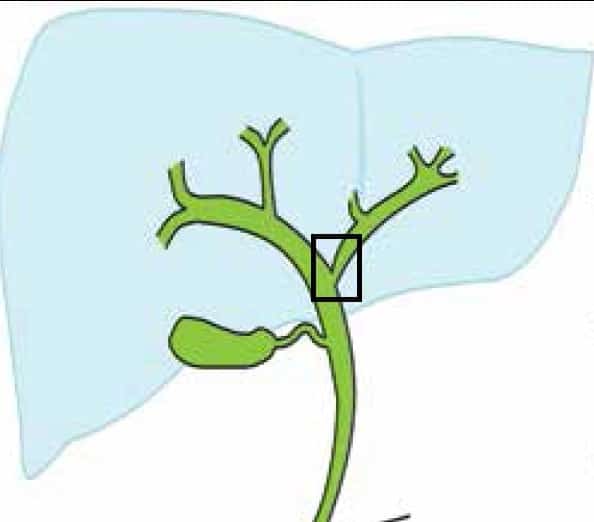
Tumor arising from the site as shown in the image is known as :
A. Krukenberg Tumor
B. Signet ring cell carcinoma
C. Klatskin Tumor
D. Onchocytoma
Show Answer

|
Correct Answer » C Explanation |
 |
Ans:C. Klatskin Tumor.
A Klatskin tumor (or hilar cholangiocarcinoma) is a cholangiocarcinoma occurring at the confluence of the right and left hepatic bile duct.
Cholangiocarcinoma
- They are malignancies of the biliary duct system that may originate in the liver and extrahepatic bile ducts, which terminate at the ampulla of Vater.
They are encountered in three anatomic regions: intrahepatic, extrahepatic (ie, perihilar), and distal extrahepatic.
- Perihilar tumors are the most common CCCs, and intrahepatic tumors are the least common.
- Perihilar tumors, also called Klatskin tumors occur at the bifurcation of right and left hepatic ducts.
- They are further classified based on anatomic location by the Bismuth-Corlette classification
-
-
- Type I tumors are confined to the common hepatic duct,
-
-
-
- Type II tumors involve the bifurcation without involvement of the secondary intrahepatic ducts.
- Type IIIa and IIIb tumors extend into the right and left secondary intrahepatic ducts, respectively.
- Type IV tumors involve both the right and left secondary intrahepatic ducts
- Distal extrahepatic tumors are located from the upper border of the pancreas to the ampulla.
-
- More than 90% are adenocarcinomas, and the remainder are squamous cell tumors.
- Morphologically, they are divided into nodular (the most common type), scirrhous, diffusely infiltrating, or papillary.
Known risk factors for cholangiocarcinoma include :
- Primary sclerosing cholangitis .
- Infection with the parasitic liver flukes Opisthorchis viverrini or Clonorchis sinensis,
- Chronic Typhoid Carriers,
- Polycystic disease of Liver,
- Congenital Anomaly with ectatic ducts (Choledochal cyst),
- Ulcerative Colitis
- Exposure to Thorotrast (thorium dioxide).
Signs and symptoms of cholangiocarcinoma include the following:
- Jaundice
- Jaundice is the most common manifestation of bile duct cancer .The obstruction and subsequent cholestasis tend to occur early if the tumor is located in the common bile duct or common hepatic duct. Jaundice often occurs later in perihilar or intrahepatic tumors .
- Clay-colored stools
- Bilirubinuria (dark urine)
- Pruritus
- Weight loss
- Abdominal pain
- If the cholangiocarcinoma is located distal to the cystic duct takeoff, the patient may have a palpable gallbladder, which is commonly known as Courvoisier sign.
