
Question
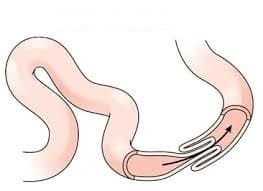
Peak incidence of the condiition among children as shown in the image is:
A. 0-3 months
B. 3-9 months
C. 3-5 years
D. >5 years.
Show Answer

|
Correct Answer » B Explanation |
 |
Ans: B. 3-9 months
The image shows Intussusception
Intussusception
- It is a medical condition in which a part of the intestine folds into the section next to it. It typically involves the small bowel and less commonly the large bowel.
Cause:
- Risk factors in children include gastroenteritis, Peyer’s Patch Hypertrophy ,cystic fibrosis, and intestinal polyps.
- Risk factors in adults include endometriosis, bowel adhesions, and intestinal tumors.
Epidemiology:
- The condition is diagnosed most often in infancy and early childhood. Its incidence begins to rise at about one to five months of life, peaks at four to nine months of age, and then gradually declines at around 18 months.
- Intussusception occurs more frequently in boys than in girls, with a ratio of approximately 3:1.
Clinical Features:
- Early symptoms can include periodic abdominal pain, nausea, vomiting (sometimes green in color from bile),and intermittent moderate to severe cramping abdominal pain.
- Later signs include rectal bleeding, often with “red currant jelly” stool (stool mixed with blood and mucus), and lethargy.
- Physical examination may reveal a “sausage-shaped” mass, felt upon palpating the abdomen.
Diagnosis:
- Ultrasound is the imaging modality of choice for diagnosis . The appearance of target sign (also called “doughnut sign” on a sonograph, usually around 3 cm in diameter, confirms the diagnosis. The image seen on transverse sonography or computed tomography is that of a doughnut shape, created by the hyperechoic central core of bowel and mesentery surrounded by the hypoechoic outer edematous bowel.
Classification
- Ileoileal – 4%
- Ileocolic – 77%
- Ileo-ileo-colic – 12%
- Colocolic – 2%
- Multiple – 1%
- Retrograde – 0.2%
- Others – 2.8%.
Treatment:
- The intussusception can be treated with either a barium or water-soluble contrast enema or an air-contrast enema, which both confirms the diagnosis of intussusception, and in most cases successfully reduces it. The success rate is over 80%.
- Cases where it cannot be reduced by an enema or the intestine is damaged require surgical reduction.
- Recurrent intussusception occurs in 5 to 10% of patients, independent of whether the bowel is reduced radiographically or surgically.
