


Question
A 17-year-old girl presented to the emergency department with skin lesion over the face as shown in the image.She had been well until 15 days before presentation, when she noticed a small, painless, itchy lesion on her face that quickly enlarged to the present condition.
Exposure to contaminated soil and livestock products is present.What can be the most probable causative organism?

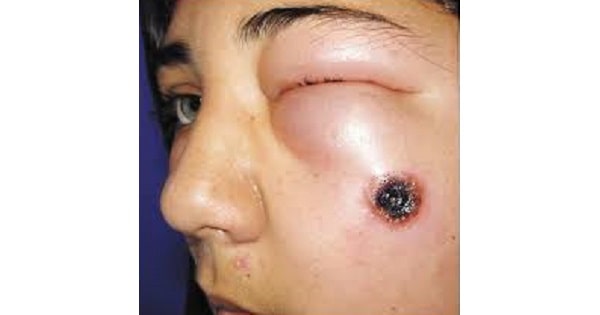
A. Staphylococcus Aureus
B. Streptococcus Pyogens
C. Tinea faciei
D. B.Anthracis.
Show Answer


|
Correct Answer » D Explanation |
 |

Ans:D. B.Anthracis.
The patient is suffering from Cutaneous Anthrax.
Anthrax
- It is a zoonotic infection caused by Bacillus anthracis.
- Man is relatively resistant to infection with B. anthracis.
- Most anthrax is cutaneous (95%); the remaining cases are inhalational (5%) and gastrointestinal (< 1%).
Signs and symptoms
- Depending on the route of exposure to B anthracis spores (ie, handling of sick animals or contaminated wool, hair, or hides,insect bites; inhalation; or ingestion of contaminated meat products), patients may present with cutaneous, respiratory, or GI complaints, respectively.
Cutaneous anthrax
- Develops 1-7 days after skin exposure
- Lesions most commonly develop at lacerations, abrasions, or fly bites on exposed areas.
- Begins as a pruritic papule that enlarges within 24-48 hours to form a 1-cm vesicle and subsequently becomes an ulcer surrounded by an edematous halo
- Lesions are usually approximately 2-3 cm in diameter and have a round, regular, and raised edge
- The skin in infected areas may become edematous and necrotic but not purulent
- Lesions are painless but on occasion are slightly pruritic
- Regional lymphadenopathy of the nodes .
- The anthrax ulcer and surrounding edema evolve into a black eschar within 7-10 days and last for 7-14 days before separating and leaving a permanent scar
Intestinal anthrax
- Hemorrhagic Enteritis
Inhalational anthrax(Wool Sorter’s Disease)
- Inhalational anthrax begins abruptly, usually 1-3 days (range, 1-60 days) after exposure, and follows a biphasic course. Less than 100 spores can cause pulmonary infection .
- Initial manifestations include the following:Flu like Symptoms
- Transient clinical improvement may occur after the first few days, followed by rapid progression and clinical deterioration in which the following signs and symptoms may be present:
- High fever
- Severe shortness of breath
- Tachypnea
- Cyanosis
- Profuse diaphoresis
- Hematemesis
- Chest pain, which may be severe enough to mimic acute myocardial infarction
- Decreased level of consciousness, meningismus, and coma (with meningeal involvement)
- Shock
Diagnostic studies may include the following:
- Staining of cutaneous ulcer exudate with methylene blue or Giemsa stain:chains of large gram positive rods.
- M’ Fadyean’s reaction represents the capsular material and is characteristic of the anthrax bacillus.
- Culture:Inverted fir tree appearance
- Ascoli thermoli precipitin test.
- ELISA
Management
- Antibiotics, such as fluoroquinolones (ciprofloxacin), doxycycline, or penicillin