Question
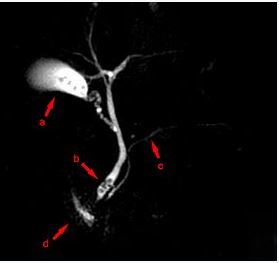
Which among the following is true regarding principle of the diagnostic technique shown in the picture below ?
A. Use of IV Gadolinium contrast agent is used to enhance the biliary radicals and the pancreatic duct.
B. Contrast agent is instilled percutaneously into the biliary radicals first and then MRI done.
C. Intraluminal dye is used to create the three dimensional view of the biliary radicals and the pancreatic duct.
D. Left hepatic duct crosses IV segmentd) Use of heavily T2 weighted images without contrast.
Show Answer
|
Correct Answer » D
Explanation
|
|
The diagnostic technique shown in the picture above represents MRCP.
No contrast material is used in MRCP. It is performed with the use of heavily T2-weighted MR pulse sequences.
On heavily weighted T2 sequences, stationary or slow-flowing fluid within the bile and pancreatic ducts appear very bright relative to the low signal intensity produced by adjacent solid tissues.
Magnetic resonance cholangiopancreatography (MRCP)
- Magnetic resonance cholangiopancreatography (MRCP) is a noninvasive technique for evaluating the intrahepatic and extrahepatic bile ducts and the pancreatic duct.
- Unlike conventional endoscopic retrograde cholangiopancreatography (ERCP), MRCP does not require contrast material to be administered into the ductal system. Thus, the morbidity associated with endoscopic procedures and contrast materials is avoided. However, MRCP does not currently allow any intervention to be performed, such as stone extraction, stent insertion, or biopsy.
- The technique is performed with the use of heavily T2-weighted MR pulse sequences. These had the effect of making stationary or slow-flowing fluid within the bile and pancreatic ducts to appear very bright relative to the low signal intensity produced by adjacent solid tissues.
- Pulse sequences used in MRCP are RARE (rapid acquisition with relaxation enhancement) and HASTE (half-Fourier acquisition single-shot turbo spin-echo)
- MRCP has established role in the investigation of many biliary disorders, serving as a non-invasive alternative to endoscopic retrograde cholangiopancreatography (ERCP).