
Question
What does this wave marked by an arrow in the ECG represents?
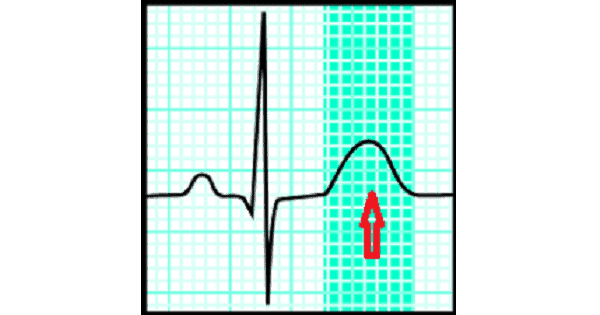
A. Ventricular Depolarisation
B. Ventricular Repolarisation
C. Atrial Depolarisation
D. Atrial Repolarisation
Show Answer

|
Correct Answer » B Explanation |
 |
Ans:B. Ventricular Repolarisation.
The wave marked by an arrow in the ECG represents T wave.
| Feature | Description |
| P wave | The p-wave represents depolarization of the atria. Atrial depolarization spreads from the SA node towards the AV node, and from the right atrium to the left atrium. |
| PR interval | The PR interval is measured from the beginning of the P wave to the beginning of the QRS complex. This interval reflects the time the electrical impulse takes to travel from the sinus node through the AV node. |
| QRS complex | The QRS complex represents the rapid depolarization of the right and left ventricles. The ventricles have a large muscle mass compared to the atria, so the QRS complex usually has a much larger amplitude than the P-wave. |
| J-point | The J-point is the point at which the QRS complex finishes and the ST segment begins. |
| ST segment | The ST segment connects the QRS complex and the T wave; it represents the period when the ventricles are depolarized. |
| T wave | The T wave represents the repolarization of the ventricles. It is generally upright in all leads except aVR and lead V1. |
| Corrected QT interval (QTc) | The QT interval is measured from the beginning of the QRS complex to the end of the T wave. Acceptable ranges vary with heart rate, so it must be corrected to the QTc by dividing by the square root of the RR interval. |
| U wave | The U wave is hypothesized to be caused by the repolarization of the interventricular septum. It normally has a low amplitude, and even more often is completely absent. |
