
Question
From the following given options,which of the following medication does not give rise to the ECG abnormality as shown in the image?
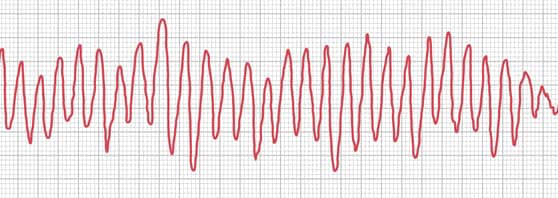
A. Sotalol.
B. Fleicainide.
C. Magnesium Sulfate.
D. Qunidine.
Show Answer

|
Correct Answer » C Explanation |
 |
Ans: C. Magnesium Sulfate.
ECG in the image shows features of Torsades de pointes.
Torsades de pointes
- It is a distinctive polymorphic ventricular tachycardia in which the QRS amplitude varies and the QRS complexes appear to twist around the baseline.
- Torsades de pointes is associated with a prolonged QT interval, which may be congenital or acquired.
- Torsades de pointes may degenerate into sustained ventricular tachycardia or ventricular fibrillation.
- Torsades is a life-threatening arrhythmia and may present as sudden cardiac death in patients with structurally normal hearts.
Risk factors
- Congenital long QT syndromes – eg, Jervell and Lange-Nielsen syndrome, Romano-Ward syndrome.
- Acquired long QT syndromes:
- Acute myocardial infarction.
- Drugs – eg,Antiarrhythmic drug class IA agents (eg, quinidine, procainamide, disopyramide), class IC agents (eg, encainide, flecainide), and class III agents (eg, sotalol, amiodarone)., erythromycin, ketoconazole, tricyclic antidepressants, methadone, antipsychotics.
- Electrolyte disturbances; hypokalaemia, hypomagnesaemia, hypocalcaemia.
- Acute kidney injury, liver failure.
- Metabolic; hypothyroidism, anorexia nervosa, malnutrition.
- Bradycardia; sinoatrial disease, atrioventricular (AV) block.
- Toxins; heavy metals, insecticides.
Presentation
- Episodes of torsades in patients with congenital long QT syndromes may be triggered by stress, fear or physical exertion.
- Patients with torsades usually present with recurrent episodes of palpitations, dizziness, and syncope.Sudden cardiac death can occur with the first episode.
- Nausea, pallor, cold sweats, shortness of breath and chest pain may occur.
- A history of congenital deafness or a family history of sudden death may indicate a long QT syndrome.
ECG:
- Paroxysms of 5-20 beats, with a heart rate faster than 200 beats per minute. Sustained episodes are occasionally seen.
- Progressive change in polarity of QRS about the isoelectric line occurs with complete 180° twist of QRS complexes in 10-12 beats.
- Usually, a prolonged QT interval and pathological U waves are present. The most consistent indicator of QT prolongation is a QT of 0.60 seconds or longer or a QTc (corrected for heart rate) of 0.45 seconds or longer.
