

Question
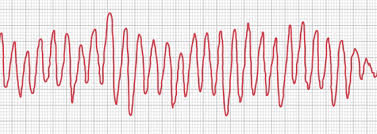
The condition shown in the picture below causes ?

A. Wide QRS.
B. Short QRS.
C. Wide QT.
D. Short QT.
Show Answer


|
Correct Answer » C Explanation |
 |

The condition shown in the picture above represents Torsade de pointes.
Torsade de pointes causes Wide QT.
- Torsades – de pointes is a cardiac arrhythmia, which may cause blackouts or even sudden death° (d/t ventricular fibrillation).
- The phrase “Torsades de pointes” literally means “Twisting of the point” referring to the characteristic appearance of the electrocardiogram during the rhythm abnormality.
- Torsade is defined as polymorphous VT in which the morphology of the QRS complexes varies from beat to beat.
- The ventricular rate can change from 150 beats per minute to 250 hpm.
- The regular variation of the morphology of the QRS vector changes .from positive to net negative and back again.
- Thus the QRS complexes tend to he bizzare and multiform. and to have sharply pointed apices or nadirs.
- Both, the QRS form and axis undulate.
Thus, the sharp points of the QRS complex may, for a short period of a few seconds, be directed upwards, to be followed, for a short period of few seconds by a change in the QRS contour where the sharp points are directed downwards.
- This was symbolically termed “Torsades – de pointes” or “twisting of the point” about the isoelectric axis because it is reminiscent of the Torsades – de pointes movement in the ballet.
- Most cases exhibit polymorphism, but the axis changes may not have regularity.
- The definition also requires that the OT interval be increased markedly (usually to 600msec or greater).
- Cases of polymorphous VT, which are not associated with a prolonged QT interval, are treated as generic VT . Torsades usually occurs in bursts that are not sustained; thus, the rhythm strip usually shows the patient’s baseline QT prolongation.
The underlying basic for rhythm disturbance is delay in the phase 3 of action potentiate.
The delay is mediated by sodium or potassium channels.
- The prolonged period of repolarization and the inhomogeneity of repolarization times among myocardial fibres allow dysrhythmia to emerge.