
Question
Identify this gastro- intestinal polyposis condition:
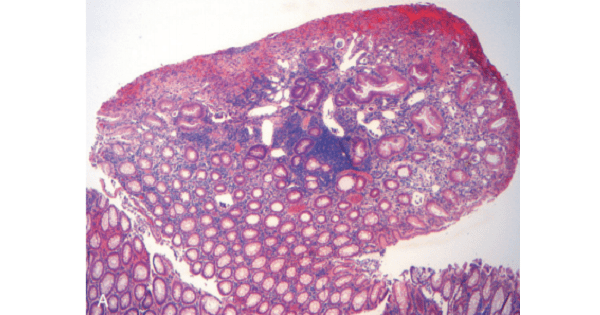
A. Hyperplastic Polyp
B. Juvenile Polyp
C. Peutz-Jeghers polyp
D. Adenoma
Show Answer

|
Correct Answer » B Explanation |
 |
Ans:B. Juvenle Polyp.
Image shows: Juvenile polyp. Note the surface erosion and cystically dilated crypts filled with mucus, neutrophils, and debris
Juvenile Polyps
- Juvenile polyps are the most common type of hamartomatous polyp.
- They may be sporadic or syndromic.
- In adults, the sporadic form sometimes is also referred to as an inflammatory polyp, particularly when dense inflammatory infiltrates are present.
- The vast majority of juvenile polyps occur in children younger than 5 years of age.
- Juvenile polyps characteristically are located in the rectum, and most manifest with rectal bleeding.
- In some cases, prolapse occurs and the polyp protrudes through the anal sphincter.
- Sporadic juvenile polyps are usually solitary but in persons with the autosomal dominant syndrome of juvenile polyposis the number varies from 3 to as many as 100.
- Colectomy may be required to limit the hemorrhage associated with polyp ulceration in juvenile polyposis.
- Dysplasia occurs in a small proportion of (mostly syndromeassociated) juvenile polyps, and the juvenile polyposis syndrome is associated with increased risk for the development of colonic adenocarcinoma.
MORPHOLOGY :
- They typically are pedunculated, smoothsurfaced, reddish lesions that are less than 3 cm in diameter and display characteristic cystic spaces on cut sections.
- Microscopic examination shows the spaces to be dilated glands filled with mucin and inflammatory debris .
