Question
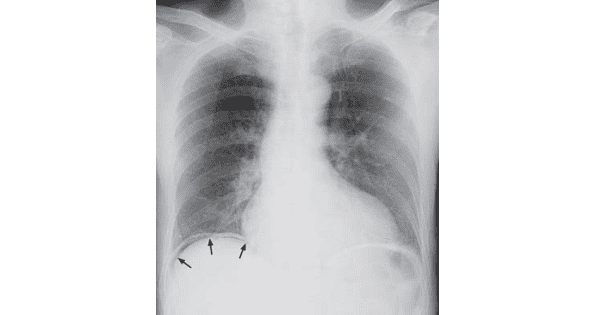
A 56-year-old man, complained of sudden onset of severeepigastric pain for one day. General examination revealed that the patient was afebrile but in severe pain.
Abdominal examination showed generalized tenderness and guarding of the abdomen with ‘board like’ rigidity. Laboratory investigations were essentially normal.
An erect chest x-ray (CXR) was performed as initial investigations.What can be the most probable diagnosis?
A. Intestinal Obstruction
B. Acute Appendicitits
C. Pneumoperitoneum
D. Acute Pancreatitis
Show Answer
|
Correct Answer » C
Explanation
|
|
Ans:C. Pneumoperitoneum
Image shows:
- ‘Free gas under diaphragm’ – indicates free peritoneal gas between the dome of the hemidiaphragm and superior surface of liver.
PNEUMOPERITONEUM
- Pneumoperitoneum (gas within the peritoneal cavity) may be due to many causes, including:
- – Gastro-intestinal tract perforation (peptic ulcer, diverticulum, ischaemic bowel, etc.)
- – Penetrating injury of the abdomen
- – Pneumomediastinum with peritoneal extension
- – Gas-forming intraperitoneal infection
- – Air entering via the female genital tract
- – An erect CXR is the initial imaging investigation of choice.
- – If this is not possible, an AXR in the left lateral decubitus position (lying on the side with left side of body dependent) is an alternative. This way, any free gas will float to the nondependent part of the peritoneal cavity (i.e. right side).
Radiographic signs include:
- Rigler’s sign – bowel wall outlined by intraluminal (normal) and peritoneal gas (abnormal)
- Triangular sign – gas collecting between adjacent bowel loops