Question
An 80-year-old man presented with colicky abdominal pain, constipation for three days, and repeated vomiting for 1 day. Physical examination showed a distended abdomen with hyperactive bowel sounds.
No abdominal mass or organomegaly was detected. Laboratory investigations were unremarkable. A supine Abdominal Xray was performed as an initial investigation.What can be the most probable diagnosis?
A. Small Bowel Obstruction
B. Large Bowel Obstruction
C. Perforated Peptic Ulceration
D. Acute Appendicitis
Show Answer
|
Correct Answer » B
Explanation
|
|
Ans:B. Large Bowel Obstruction.
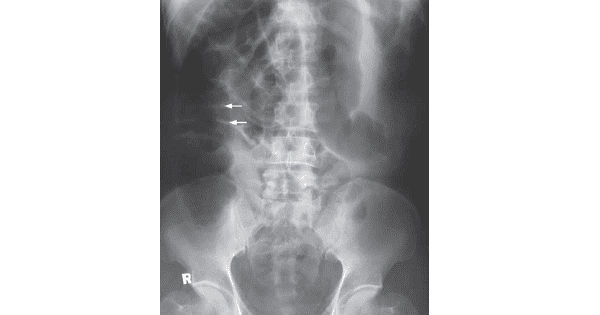
Image shows:
- Supine abdominal radiograph showing gas-filled dilated proximal large bowel and collapsed distal large bowel suggestive of mechanical large bowel obstruction.
- Gas-filled dilated bowel in the periphery of abdomen (‘picture framing’) – representing the location of the caecum, ascending, transverse and descending colon.
- Note the prominent haustra (arrows) – the widely spaced incomplete bands along the walls of the dilated bowel and absence of gas in the rectum.
MECHANICAL LARGE BOWEL OBSTRUCTION
- Dilatation of large bowel >5.5 cm is the hallmark of large bowel obstruction. Once this is diagnosed, the cause and its location requires further investigation.
- Colonoscopy and barium enema are relatively contra-indicated in acute obstruction for fear of bowel perforation. A water soluble contrast enema or CT abdomen are safe alternatives.
There are many causes of large bowel obstruction and a simple way to classify them is by location:
- Intra-luminal: e.g. faecal impaction, gallstone, intussusception
- Mural: e.g. neoplasm, infection (parasites), infl ammatory bowel disease
- Extrinsic: e.g. adjacent neoplasm (by compression or invasion), adjacent abscess, endometriosis
- In an elderly patient the most common cause is colonic carcinoma.