

Question
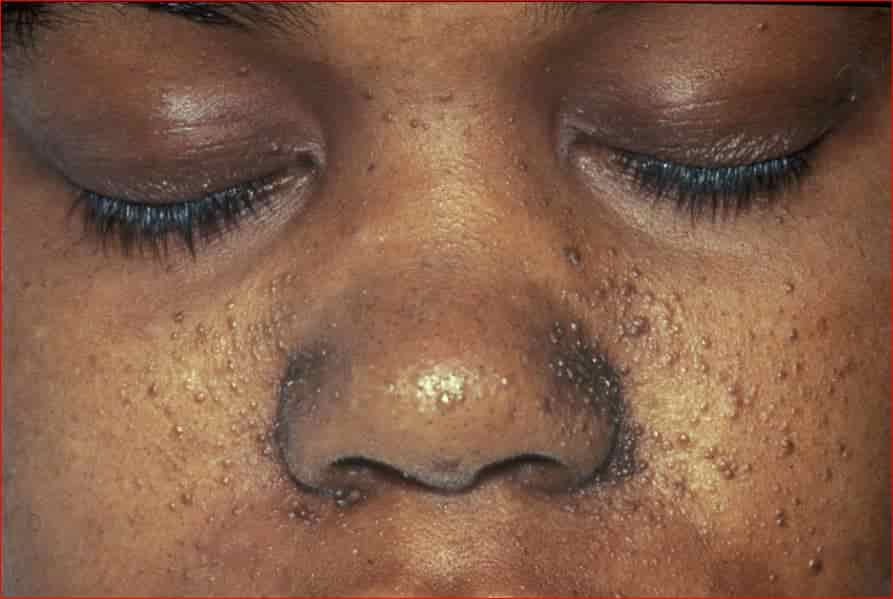
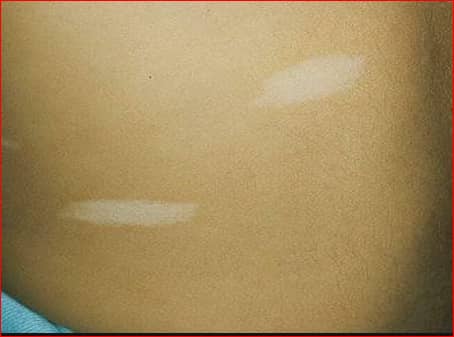
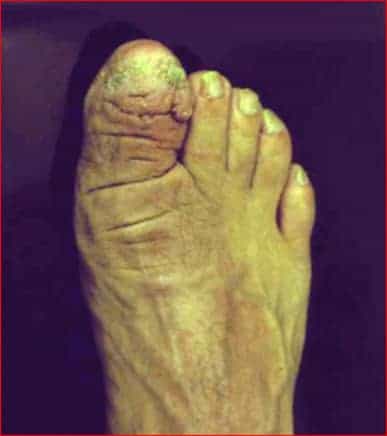
Images of a disease complex are shown.Along with these lesions ,mental retardation and epilepsy may occur in this disease complex.What is the mode of inheritance of this pathology?




A. Autosomal dominant
B. Autosomal recessive
C. X-linked dominant
D. X-linked recessive
Show Answer

|
Correct Answer » A Explanation |
 |

Ans:A.)Autosomal Dominant.
Tuberous Sclerosis Disease complex is asked in the question.
Image shows:
First: Facial angiofibromas in characteristic butterfly pattern
Second:Ash leaf macules
Third: Shagreen patches
Fourth:Dysplastic periungual fibroma
TUBEROUS SCLEROSIS
- TSC is now known to be an Autosomal dominant disorder affecting cellular differentiation, proliferation, and migration early in development, resulting in a variety of hamartomatous lesions that may affect virtually every organ system of the body.
- TSC is caused by a mutation of either of two genes, TSC1 and TSC2, which code for the proteins hamartin and tuberin, respectively.
- Diagnostic triad of Tuberous sclerosis includes epilepsy, mental retardation and adenoma sebaceum (facial angiofibroma).
| Major Criteria | ||||
|---|---|---|---|---|
| Location | Sign | Onset | Note | |
| 1 | Head | Facial angiofibromas or fibrous cephalic plaque | Infant – adult | At least three |
| 2 | Fingers and toes | Nontraumatic ungual or periungual fibroma | Adolescent – adult | At least two |
| 3 | Skin | Hypomelanotic macules | Infant – child | At least three, at least 5 mm in diameter. |
| 4 | Skin | Shagreen patch (connective tissue nevus) | Child | |
| 5 | Brain | Cortical dysplasias (includes tubers and cerebral white matter radial migration lines) | Fetus | |
| 6 | Brain | Subependymal nodule | Child – adolescent | |
| 7 | Brain | Subependymal giant cell astrocytoma | Child – adolescent | |
| 8 | Eyes | Multiple retinal nodular hamartomas | Infant | |
| 9 | Heart | Cardiac rhabdomyoma | Fetus | Single or multiple. |
| 10 | Lungs | Lymphangioleiomyomatosis | Adolescent – adult | |
| 11 | Kidneys | Renal angiomyolipoma | Child – adult | At least two. Together, 10and 11 count as one major feature. |
| Minor Criteria | ||||
| Location | Sign | Note | ||
| 12 | Teeth | At least three randomly distributed pits in dental enamel | ||
| 13 | Skin | “Confetti” skin lesions, 1–2 mm hypomelanotic papules | ||
| 14 | Gums | Intraoral fibromas | ||
| 15 | Liver, spleen and other organs | Nonrenal hamartoma | Histologic confirmation is suggested. | |
| 16 | Eyes | Retinal achromic patch | ||
| 17 | Kidneys | Multiple renal cysts | Histologic confirmation is suggested. | |