


Question
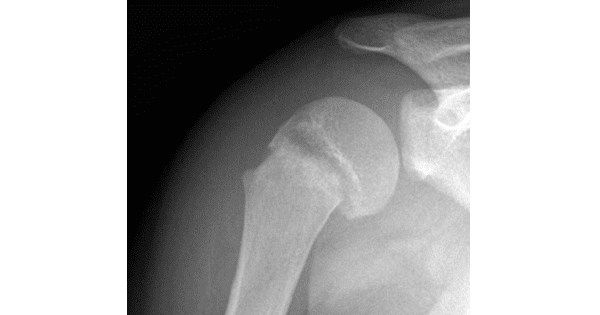
8 year old boy presented with shoulder pain after fall.X ray shows the following features.What is the most possible diagnosis?

A. Normal
B. Acromion fracture
C. Dermatomyositis
D. Salter 1 Fracture
Show Answer


|
Correct Answer » D Explanation |
 |

Ans:D. Salter 1 Fracture.
Image shows:Salter 1 Fracture of the Proximal Humeral Epiphysis. Frontal radiograph of the shoulder in external rotation demonstrates slip of the proximal humeral epiphysis medially and inferiorly (black arrow) due to a fracture through the epiphyseal plate that causes widening of the plate (white arrow).
SALTER HARRIS FRACTURES
- The epiphyseal plate (physis or growth plate) is the weakest part of the bone to shearing injuries
- The Salter-Harris classification is a means of categorizing epiphyseal plate fractures and provides clues to their prognosis
- All such these fractures, by definition, involve or extend through the epiphyseal plate so that all such fractures occur in children before the epiphyseal plate closes.
Salter-Harris I Fractures
- Occurs through the hypertrophic zone of the epiphyseal plate
- Only the epiphyseal plate is fractured
- Rarely produces complications
- May be difficult to diagnose unless there is visible displacement of the epiphysis on the metaphysis
- Slipped capital femoral epiphysis (SCFE) is an example of a Salter-Harris I fracture
Salter-Harris II Fractures
- Most common Salter-Harris fracture -85%
- Involves both the epiphyseal plate and the metaphysis
- Small corner of metaphysis that is usually fractured produces the “corner sign”
- Rarely produces complications
Salter-Harris III Fractures
- Involves the epiphyseal plate and the epiphysis itself
- Since the epiphysis is involved, damage to the articular cartilage can occur
- Growth disturbance is uncommon
- A Tillaux fracture of the ankle is a Salter-Harris III fracture
Salter-Harris IV Fractures
- Involves the epiphyseal plate, metaphysis and epiphysis
- Since it, too, involves the epiphysis, the articular cartilage can be damaged
- Since these fractures involve the growing layer of cartilage, growth disturbance can result
Salter-Harris V Fractures
- Compression or crushing injury of epiphyseal plate
- Initial diagnosis may be difficult and not made until complication of growth disturbance at epiphyseal plate occurs resulting in angular deformities
- Associated with growth disturbance
- These injuries have the worst prognosis of the Salter-Harris fractures