Question
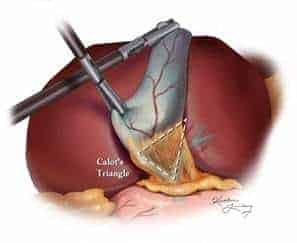
Which of the following is not a boundary of given image:
A. Common hepatic duct
B. Cystic duct
C. Inferior surface of the liver.
D. Gall bladder
Show Answer
|
Correct Answer » D
Explanation
|
|
Answer D. Gall bladder
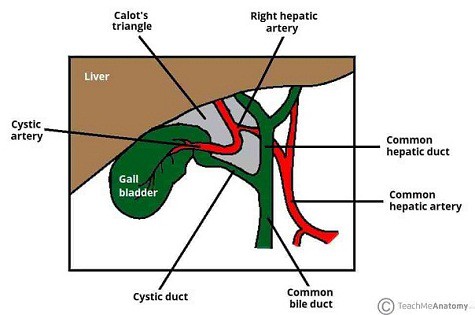
CALOT’S TRIANGLE
- Calot’s triangle (cystohepatic triangle) is a small anatomical space in the abdomen.
- It is located at the porta hepatis of the liver – where the hepatic ducts and neurovascular structures enter/exit the liver.
The borders are as follows:
-
Medial – common hepatic duct.
-
Inferior – cystic duct.
-
Superior – inferior surface of the liver.
- The above differ from the original description of Calot’s triangle in 1891 – where the cystic artery is given as the superior border of the triangle.
- The modern definition gives a more consistent border (the cystic artery has considerable variation in its anatomical course and origin).