Question
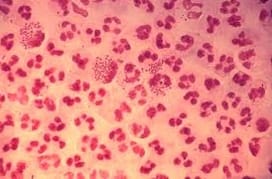
In the following gram stained specimen, identify the bacteria seen:
A. Streptococcus pneumoniae
B. Hemophilus influenzae
C. Staphylococcus aureus
D. Neisseria gonorrhoeae
Show Answer
|
Correct Answer » D
Explanation
|
|
Ans: d. Neisseria gonorrhoeae
(Ref- Ananthanarayan 8/e p50, 10/e pI3, 234)
- Pink coloured paired cocci most likely Neisseria meningitidis or N. gonorrhoeae.
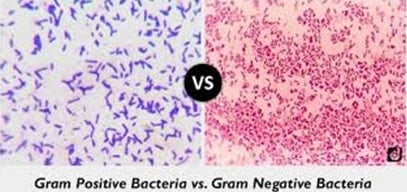
Gram’s Staining:
Gram Positive Bacteria:
- Crystal violet dye-iodine complex combines to form larger molecule precipitating in cell.
- Alcohol/acetone mixture – Acts as decolorizing agent.
- Cause dehydration of multi-layered peptidoglycan of cell wall.
- Results in decreased molecular space à Causing cell wall to trap crystal violet iodine complex within cell.
- Hence Gram-positive bacteria do not get decolorized up à retains primary dye à Appears violet.
Gram-negative bacteria:
- Alcohol (lipid solvent) à Dissolves outer lipopolysaccharide membrane of cell wall .
- Damages peptidoglycan attached cytoplasmic membrane.
- Hence, dye-iodine complex is not retained à Permeates out (during decolorization process).
- On counter stain addition à stain color taken à Appears pink.
Neisseria meningitidis or N. gonorrhoeae :
- Gram-negative diplococci.
- Gonococci – Non-encapsulated & kidney shaped diplococcic.
- Usually produce smaller colonies than those of other neisseriae.