Question
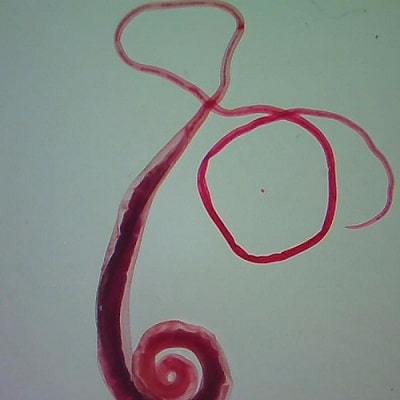
The following are images of an intestinal nematode. Which of these are true about it?
A. Transmitted through percutaneous and auto-inoculation
B. Embryonated egg is the infectious stage for this worm
C. The adult worm usually lives in the small intestine
D. Triclabendazole is the drug of choice
Show Answer
|
Correct Answer » D
Explanation
|
|
Ans: D. Triclabendazole is the drug of choice
(Ref Paniker’s 7/e p172, 6/e p166; Jawetz 27/e p724; Harrison 19/e p1416)
- Image suggestive of Trichuris trichura.
Forms:
Embryonated forms:
- Egg also present in image.
- Infectious stage.
- Transmitted via oral route.
Adults:
Adult female whipworms:
- Approximately 30-50 mm in length.
Adult male worms:
- Slender anterior end.
- Thicker posterior end.
- Hence appears “buggy whip” → hence name “whipworm”.
- Usually lives in large intestine & appendix.
Life cycle:
- Eggs passed in feces → Eggs infective after about 3 weeks of incubation in moist & shady soil.
- Humans acquire infection by eating foods contaminated with infective eggs.
- Swallowed eggs → larvae hatch in small intestine → mature & migrate to colon- → Cycle continues.
- DOC: Thiabendazole.