
Integumentary System
DEVELOPMENT OF SKIN:
- Epidermis & its appendages, pilo sebaceous unit, nail & sweat glands: Surface ectoderm
- Melanocyte Et Merkel cells: Neural crest
- Langerhan’s cells: Bone marrow
- Dermis in limbs & trunks: Somatopleuric mesenchyme
- Dermis in face, Head Et neck: Neural crest
- Skin and facia of great toe drains into Vertical group of superficial inguinal lymph nodes
- It has been calculated that a human adult has about 1012 bacteria on the skin
- Density of bacterial population at most sites is between 100-1000 per square cm.
LAYERS OF SKIN:

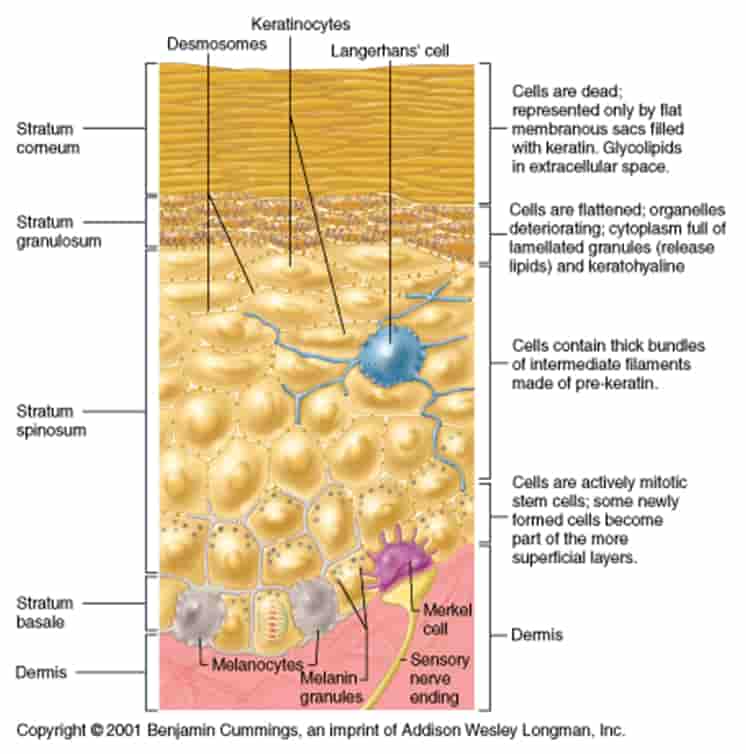
- Skin is the largest organ in the body.
- Total surface area: 1.7m2.
- The layers of the skin are
- Epidermis
- Dermis
- Subcutaneous fat/ hypodermis
EPIDERMIS
- 0.4 -1.6 mm in thickness
- Layers of epidermis:
| Stratum corneum (Horny cell layer) |
|
| Stratum lucidum |
|
| Stratum granulosum |
|
|
Stratum spinosum or
Prickle cells layer Malphigian layer |
|
|
Stratum basale or
Stratum germinatum |
|
Cells in the epidermis:
- keratinoytes
- melanocytes
- Merkel cells
- Langerhans’ cells
- Langerhans cells – antigen-presenting cells, derived from bone-marrow and found in the prickle cell layer.
- Langerhans cells are found scattered evenly throughout the epidermis.
- Merkel cells are normally located in the basal layer
- slow adapting mechanoreceptors found in prickle cell layer.
- Keratinization: conversion of keratinocyte into keratin (4 weeks)
- Keratin filaments are hallmark of keratinocyte
- Adamson’s fringe: beginning of Keratinization
- Keratin expressed in basal layer: K5, K14
Development:
- 1 epidermal melanocyte unit: 36 keratinocytes
- Skin doubling time: 4 weeks
- Epidermal turn over time: 1 month
- Accelerated cell turnover: psoriasis and ichthyosiform erythroderma 2 to 4 days
- Nail first develops at: 3 months of intra uterine life
- Finger nail growth: 0.1mm/day
- Scalp hair growth: 0.35 mm/day
- Number of hair normally lost pev day:50-100
- Factors stimulating skin development (Epidermopoiesis): EGF, TGF-a, IL-II & fibroblast growth factor.
- Factors inhibiting skin development: Chalones, TGF-B, a and y interferons, TNF
- Grenz zone: narrow clear zone B/W epidermis & dermis.
- Racial variations in pigmentation are due to differences in melanocyte morphology and activity rather than to differences in frequency or distribution
- Function of the epidermis layer of the skin provides a waterproof barrier and creates our skin tone.
DERMIS:
- Flexible and strong connective tissue
- Elastic, reticular and collagen fibers
- Cells: fibroblasts, macrophages (WBC), mast cells (histamine).
- Nerves, blood and lymphatic vessels Oil and sweat glands originate
Two layers:
- Papillary layer:
- Loose connective tissue with nipple like surface projection called dermal papilla.
- Capillaries
- Contain pain receptors
- Contain touch receptors (Meissner’s corpuscles)
- Dermal ridges- epidermal ridges- pattern called fingerprints
Reticular layer:
- Dense irregular c.t.
- Collagen fibers offer strength
- Holds water
- Dermal tearing causes stretch marks.
- Striae
Hair (pili)
- Main function is protection
- Hair root nerve plexus for touch
- Normal hair loss in adult 70-100 hairs/day
Nerve endings:
- Exteroceptors (stimulus outside of body)
- Pacinian (lamellated) corpuscles: deep pressure and stretch
- Meissner’s (tactile) corpuscles: light touch, vibration and discriminative touch.
- Hair root plexus
- Free (naked) nerve endings: nociceptors (pain) and thermoreceptors ( hot – deep and cold- surface)
- Ruffini’s corpuscles: deep pressure
- Haascheiben cells in epidermis are responsible for Touch
HYPODERMIS:
- Called subcutaneous, Sub- or superficial fascia
- Anchors skin to underlying structures
- Contains adipose tissue and blood vessels
- Common site for injection
Exam Important
- The portion of the skin that serves as a barrier to water loss is the Epidermis
- Melanoblast cells appear in basal layer of epidermis during 3rd month of intrauterine life
- Lymphatics are found in Dermis of skin
- Stratum corneum is underdeveloped in the VLBW infants in the initial 7 days
- Normal turnover time of epidermis (skin doubling time) is 4 weeks
- Function of the epidermis layer of the skin provides a waterproof barrier and creates our skin tone.
- Haascheiben cells in epidermis are responsible for Touch
- Dead layer of epidermis is Stratum corneum
- Skin and facia of great toe drains into Vertical group of superficial inguinal lymph nodes
- It has been calculated that a human adult has about 1012 bacteria on the skin
- Density of bacterial population at most sites is between 100-1000 per square cm.
Don’t Forget to Solve all the previous Year Question asked on Integumentary System
Click Here to Start Quiz
Click Here to Start Quiz

