
Integumentary System
| A | Dermis | |
| B |
Subcutaneous tissue |
|
| C |
Deep fascia |
|
| D |
Epidermis |
The portion of the skin that serves as a barrier to water loss is the:
| A |
Dermis |
|
| B |
Subcutaneous tissue |
|
| C |
Deep fascia |
|
| D |
Epidermis |
Melanoblast cells appear in basal layer of epidermis during-
| A |
3rd month of intrauterine life |
|
| B |
5th month of intrauterine life |
|
| C |
7th month of intrauterine life |
|
| D |
8th month of intrauterine life |
A i.e. 3rd Month of intrauterine life
Melanoblast cell appear in basal layer of epidermis during 3rd month of intrauterine life
Lymphatics are found in :
| A |
Brain |
|
| B |
Choroid |
|
| C |
Internal ear |
|
| D |
Dermis of skin |
D. i.e. Dermis of skin
Which layer of epidermis is underdeveloped in the VLBW infants in the initial 7 days:
| A |
Stratum germinativum |
|
| B |
Stratum granulosum |
|
| C |
Stratum lucidum |
|
| D |
Stratum corneum |
D i.e. Stratum corneum
Normal turnover time of epidermis (skin doubling time) is
| A |
2 weeks |
|
| B |
4 weeks |
|
| C |
6 weeks |
|
| D |
8 weeks |
B i.e. 4 weeks
The skin is the largest organ of the body, with a total area of about 20 square feet.What is the function of the epidermis layer of the skin?
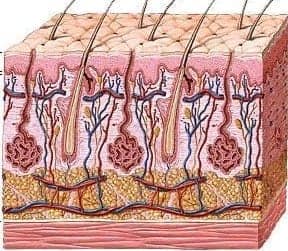
| A |
provides a waterproof barrier and creates our skin tone. |
|
| B |
contains tough connective tissue, hair follicles, and sweat glands. |
|
| C |
made of fat and connective tissue. |
|
| D |
All of the above |
Skin has three layers:
- The epidermis, the outermost layer of skin, provides a waterproof barrier and creates our skin tone.
- The dermis, beneath the epidermis, contains tough connective tissue, hair follicles, and sweat glands.
- The deeper subcutaneous tissue (hypodermis) is made of fat and connective tissue.
The skin’s color is created by special cells called melanocytes, which produce the pigment melanin. Melanocytes are located in the epidermis.
Haascheiben cells in epidermis are responsible for‑
| A |
Touch |
|
| B |
Temperature |
|
| C |
Pressure |
|
| D |
Proprioception |
Ans. is ‘a’ i.e., Touch
Dead layer of epidermis ‑
| A |
Stratum basale |
|
| B |
Straum spinosum |
|
| C |
Stratum corneum |
|
| D |
Stratum granulosum |
Ans. is ‘c’ i.e., Stratum corneum
- Stratum basale, stratum spinosum and stratum granulosum, together form the living layer and constitute the site of synthesis of keratin (Keratin is mostly synthesized in stratum spinosum).
- Stratum corneum is the dead layer.
Layers of epidermis (From deep to superficial)
In palm & sole (5 layers). Elsewhere (4 layers)
Stratum basale Stratum basale
Stratum spinosum Stratum spinosum
Stratum granulosum iv)Stratum lucidum Stratum granulosum
Stratum corneum Stratum corneum
Skin and facia of great toe drains into ‑
| A | Vertical group of superficial inguinal lymph nodes | |
| B | Horizontal group of superficial inguinal lymph nodes | |
| C |
Obturator lymph nodes |
|
| D |
Deep inguinal lymph nodes |
Ans. is ‘a’ i.e., Vertical group of superficial inguinal lymph nodes
- Lymphatics from skin and superficial fascia of great toe accompany great saphenous vein and drain into vertical group of superficial inguinal lymph nodes.
| A |
10′- 102 |
|
| B |
102– 105 |
|
| C |
105– 010 |
|
| D |
>1010 |
Ans. is ‘d’ i.e., >1010
- It has been calculated that a human adult has about 1012 bacteria on the skin.
| A |
10′- 102 |
|
| B |
102– 103 |
|
| C |
105– 1010 |
|
| D |
>10′ |
Ans. is `b’ i.e., 102– 103
- Density of bacterial population at most sites is between 100-1000 per square cm.
