

Atherosclerosis
ATHEROSCLEROSIS
- Atherosclerosis is an thickening & hardening muscular arteries which is characterised by soft gramous lipid cores (atheromatous plaque).
- It is the commonest & most important arterial disease.
- Most commonly affected are aorta, coronaries & cerebral arterial system.
- Most commonly coronoary circulation affected is – Left anterior descending artery

Etiology–

Pathogenesis-
- Most widely accepted theory for atherosclerosis is inflammatory response to endothelial injury.
- According to this hypothesis, atherosclerosis is a chronic inflammatory response of the arterial wall initiated by injury to endothelium.
- Hyperlipidemia, hypertension, smoking can cause endothelial injury.
- Foam cells are formed when macrophages & smooth muscle cells accumulated oxidised LDL.
- Chlamydia Pneumoniae presents the strongest association with human atherosclerosis.

Morphological features-
1. Fatty streaks & Dots- are the earliest lesions composed of intimal collections of foamy macrophages & smooth muscle cells.
- Prominent in the aorta (often in posterior wall)
2. Gelatinous lesions- develop in the intima of the aorta.
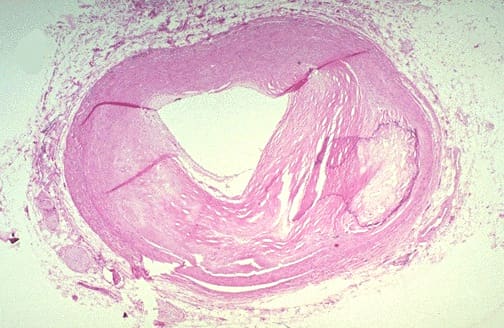
3. Artheromatous plaques (arthemaous lesions/ fibrous plaque)-
- Most severely affected is the abdominal aorta.
- Involves iliac, femoral, carotid, coronary & cerebral arteries.
- Superficial luminal part of the fibrous cap (convex) composed by smooth muscle cells.
- Cellular area under fibrous cap composed of macrophages, foam cells, lymphocytes.
- Deeper central soft core consists of cholesterol clefts, fibrin, necrotic debris & lipid- laden foam cells.
4. Complicated plaques-
- Calcification- occurs more commonly in advanced athermatous plaques.
- Ulceration
- Thrombosis- superimposed thrombi
- Haemorrhage

Clinical features-
Major clinical effects of atheroscelrosis are-
- Heart (coronary artery disease, IMD, MI)
- Brain (stroke)
- Aorta (aneurysmal dilatation)
- Intestine (ischaemia, infarct)
- Lower extremities (gangrene)
- Blood vessels affected by atherosclerosis- abdominal aorta (most commonly), Circle of Willis (least commonly affected)
Exam Important
- Most commonly affected are aorta, coronaries & cerebral arterial system.
- Most commonly coronoary circulation affected is – Left anterior descending artery
Etiology–
Pathogenesis-
- Most widely accepted theory for atherosclerosis is inflammatory response to endothelial injury.
- According to this hypothesis, atherosclerosis is a chronic inflammatory response of the arterial wall initiated by injury to endothelium.
- Hyperlipidemia, hypertension, smoking can cause endothelial injury.
- Foam cells are formed when macrophages & smooth muscle cells accumulated oxidised LDL.
- Chlamydia Pneumoniae presents the strongest association with human atherosclerosis.
Morphological features-
1. Fatty streaks & Dots- are the earliest lesions composed of intimal collections of foamy macrophages & smooth muscle cells.
- Prominent in the aorta (often in posterior wall)
2. Gelatinous lesions- develop in the intima of the aorta.
3. Artheromatous plaques (arthemaous lesions/ fibrous plaque)-
- Most severely affected is the abdominal aorta.
- Involves iliac, femoral, carotid, coronary & cerebral arteries.
- Superficial luminal part of the fibrous cap (convex) composed by smooth muscle cells.
- Cellular area under fibrous cap composed of macrophages, foam cells, lymphocytes.
- Deeper central soft core consists of cholesterol clefts, fibrin, necrotic debris & lipid- laden foam cells.
4. Complicated plaques-
- Calcification- occurs more commonly in advanced athermatous plaques.
- Ulceration
- Thrombosis- superimposed thrombi
- Haemorrhage
- Blood vessels affected by atherosclerosis- abdominal aorta (most commonly), Circle of Willis (least commonly affected)
Don’t Forget to Solve all the previous Year Question asked on Atherosclerosis

