

Barrier Methods of contraceptions
CONDOM:
- Made of latex
- Water-based spermicides should be used.
- Because of irritation by latex in some women, nonlatex polyurethane condoms are available.
METHOD:
- Unroll over erect penis after pulling back the foreskin
- Airfree space should be left by squeezing the tip
- Glycerine, K-Y jelly or spermicidal jelly used as lubricant
Failure :
- Due to incorrect use
- 10-20 percent
Uses:
- Prevent STD, Syphilis and HIV
- Less human papilloma virus and herpes virus.
- For 12 ejaculation following vasectomy
- For 3 months, condom use is advocated, if sperm antibodies are the cause of infertility.
- To prevent transmission of gonococcal, chlamydia, syphilis, trichomonad and fungal infection.
- Important role in transmission of HIV from one partner to the other.
- PID is least common with Condom
Advantages:
- Easily available
- Cheap
- Easy to carry
- Least risk of ectopic pregnancy
- Emphasizes male involvement in contraceptive effort and is immediately effective.
- Prevents sperm allergy.
- No adverse effect on pregnancy
- Useful in women with rheumatic heart disease & MI
- Safe in SCA
- Nirodh brand is distributed free of cost in the government hospitals in India.
Disadvantages:
- The method is only partially reliable, having a pregnancy rate of 10–14 per 100 woman years
- Vaginal irritation to the latex.
- Contact dermatitis
OCCLUSIVE DIAPHRAGMS:
- Barrier in the vagina against direct insemination.
Effective when :
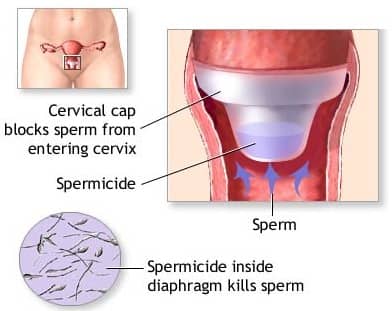
- Used in conjunction with a chemical spermicide
- Sufficient time allowed for complete destruction of the sperms
Method:
- Diaphragm liberally covered with spermicide can be inserted and is left in position for a minimum of 8 h after coitus.
- No discomfort and no douching is required when these precautions are observed.
TYPES:
- The Dutch cap or diaphragm:
- Domeshaped diaphragm of thin rubber, with a rubber-covered metal rim
Advantages:
- Easiest type
- Fits in the majority of cases,
- No discomfort
Contraindications:
- Prolapse, cystocele, rectocele
- Recurrent urinary tract infection
- Allergy to rubber or spermicidal agent.
- TSS if diaphragm is left in the vagina for a long period
- Failure rate : 4–6 per 100 woman years


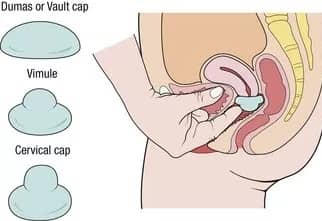
Cervical cap:
- Cup-shaped rubber somewhat like a thimble, with a solid rolled rubber rim.
Advantages:
- Prolapse of uterus and vagina
Contraindiactions:
- Chronic cervicitis, erosion and cervical laceration
Dumas cap:
- Cup-shaped rubber with a thickened rim
 Femshield (female condom):
- It is known as ‘FEM’ or Femidom
- Combined features of diaphragm and condom
- Long sheath made of polyurethane prelubricated.
Advantages:
- Coital-independent
- Does not slip off
- Stronger than the condom
- Can be worn during the puerperal period
- Failure rate is 5–20 per 100 woman years

Today:
- Mushroom-shaped polyurethane disposal sponge
- Mechanical barrier
- Placed high up in the vagina with the concave side covering the cervix

 SPERMICIDAL AGENTS:
- Kill the sperms before gaining access to the cervical canal.
Composition:
- Surfactants, such as nonoxynol-9, octoxynol and menfegol
- Enzyme-inhibiting agents
- Forms:foam tablets, soluble pessaries,creams, jellies, or as films with diaphragm, occlusive cervical cap and condom
- Spermicidal jelly acts through Disruption of cell membrane
- Failure rate is high, approximately 30 per 100 woman years when used alone.
- Effective for 1–2 h after the application
- New spermicidal cream, Tenofovir, prevents viral attachment to the vaginal mucosa and is nonirritant
- Praneem from neem is spermicidal and prevents transmission of STDs
Adverse effects:
- Irritation and abrasions in chronic use
- vaginal ulceration
- increase the risk of HIV spread
Exam Question
- Spermicidal jelly acts through Disruption of cell membrane
- Nonoxynol & Menfegol are Spermicidal agents
- Best mode of contraception for a newly married lady with rheumatic heart disease Condom
- Pelvic Inflammatory Disease occurs least common with Condom
- Condom is Unrolled over erect penis
- Air should be squeezed out of tip of Condom
- K-Y jelily may be used for lubrication of Condom
- Contact dermatitis is associated with the use of condom
- Condoms has the least risk of ectopic pregnancy
- Contraceptive failures with condoms are MOST often due to Incorrect use
- Condom or diaphragm is the safest contraceptive method for a woman with sickle-cell anaemia
- 10-20 percent is the failure rate in use of condoms.
- Dutch cap is a Diaphragm
- Best protection from STD and Syphilis is by Condom
- Condoms are more preferred because Reduced side effects
- Conventional contraception is Condom
- Failure rate of female condom 5-20 per 100 women years
Don’t Forget to Solve all the previous Year Question asked on Barrier Methods of contraceptions
