


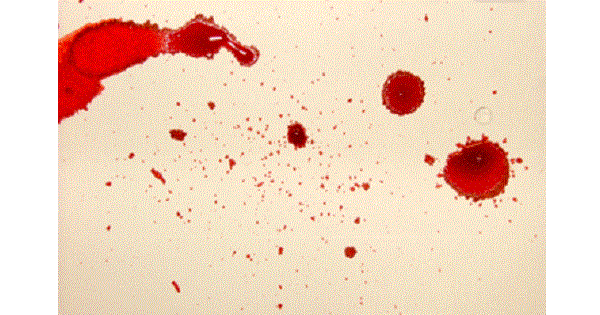
BLOOD AND BLOOD STAINS
Introduction
Blood is one of the most significant & frequently encountered types of physical evidence in forensic investigation of death & violent crimes.
Lattes crust method: The common blood groups ABO, MNS and Rh systems can be determined in a blood stain by .
Luminol spray is used to identify blood stains which are no longer visible due to washing of crime scene.
Kastle-Meyer test is used to identify visible blood stains.
Haemin crystal test is a confirmatory test for blood stains.
The points that are usually required to be determined regarding stains are:
- nature of stain (whether the stains is blood or not)
- the species (human or animal) from which the blood has come from
- blood group.
(A) Nature of stain {whether the stain is blood or not)
To determine the nature of stain, following tests are used :
1) Chemical tests
- These tests are based on the peroxidase activity of haematin, which is, derived from oxidation of haem of haemoglobin or methemoglobin present.
- This enzyme, in the presence of hydrogen peroxide converts colourless salts into coloured bases. Thus these tests are based on H2O2 and peroxidase enryme.
Tests are :
- Benzidine test : Greenish blue colour.
- Phenolphthalein test (kastle myere test): Deep permanganate colour.
- Leucomalachite green test : Bluish green or peacock blue colour.
- Guaiacum test: Blue colour.
- Orthotoludine test (kohn test) : Blue or green colour.
- Amidopyrine test: Purple colour.
2) Microchemical tests: These tests are based on property of haem part of hemoglobin to form characteristic coloured crystals.
The tests are:
- Teichmann’s haemin crystal test.(hydrogen peroxideis not used as in others.)
- Takayama hemochromogen crystal test.
- Luminal spray test : It is especially useful in old obscure blood stains.
3) Spetroscopy: It is most delicate and reliable test, It is based on the principle that hemoglobin and its derivatives give characteristic absorption bands when viewed through a spectroscope.
4) Microscopy: Microscopic examination of RBCs is possible only in fresh stains.
(B) Detection of species {whether the blood has come from human or animal}
For detection of species, serological (immunological) tests are used. These tests are :
- Precipitin test
- Haemaglutination inhibition test (antiglobulin consumption test or absorption inhibition test).
- Gel diffusion test.
- Double diftrsion test.
- Precipitation electrophoresis.
- Latex agglutination test.
- Isoenzyme method (enzymological test).
C) Detection of blood group of blood stain : These tests are :
Immunological (serological) :
- absorption-elution test, (11) absorption-inhibition test,
- mixed agglutination test,
- latex test.
- Enzymological methods.
- Lalte’s crust method

