
Candida: Diagnosis and Treatment
Laboratory diagnosis:
Specimen:
- Specimen collection depends on the site of infection.
Specimens:
- Mucosal scraping, skin & nail scraping, urine, blood, CSF, sputum etc.
Microscopy:

- Candida can be demonstrated as gram positive yeast like budding cells
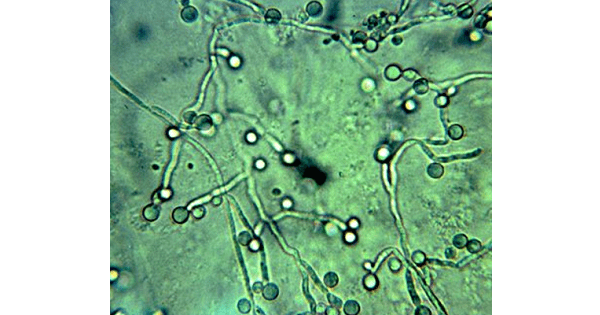
- With or without pseudohyphae(Chains of elongated yeast cells that fail to detach after budding.) on Gram smear.
- KOH mounts too can show yeast like cells.
- Calcofluor white stain is also useful in demonstration of Candida in specimens.
Culture:
- It grows readily on bacteriological medium as well as SDA at 37oC after overnight incubation.
- Colonies are white, creamy and bacteria-like.
- A positive culture does not mean that the C. albicans is pathogenic, as it may be a commensal.
Identification:
- Different species of Candida can be identified by following tests:
- Chlamydospore formation on Cornmeal Agar (Dalmau plate)
- Germ tube test (Reynaud Braude)
- Carbohydrate assimilation
- Auxanography
- Latex agglutination
Treatment:
Mucocutaneous
Cutaneous :
- Topical azoles Topical nystatin
Vulvovaginal:
- Azole cream or oral fluconazole Nystatin suppository
Oropharyngeal:
- Clotrimazole or fluconazole Nystatin
Esophageal:
- Fluconazole or itraconazole
Deeply Invasive
Non-neutropenic:
- Fluconazole or amphotericin B
Neutropenic:
- Amphotericin B
Candida endophthalmitis
- IV polyene + flucytosine
Exam Question
- Pseudohyphae of candida with budding yeasts are present on this potassium hydroxide preparation
- Ketoconazole would treat both dermatophysis and candidal infection
- Drug of choice in systemic candidiasis is Amphotericin
- Drugs used for candidiasis include Fluconazole, Nystatin, Clotrimazole, Itraconazole
- Different species of Candida can be identified by following tests:
- Chlamydospore formation on Cornmeal Agar (Dalmau plate)
- Germ tube test (Reynaud Braude)
Don’t Forget to Solve all the previous Year Question asked on Candida: Diagnosis and Treatment
