
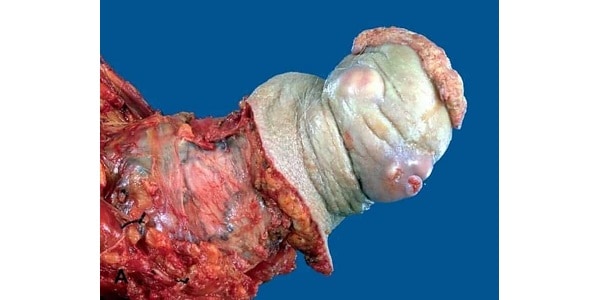
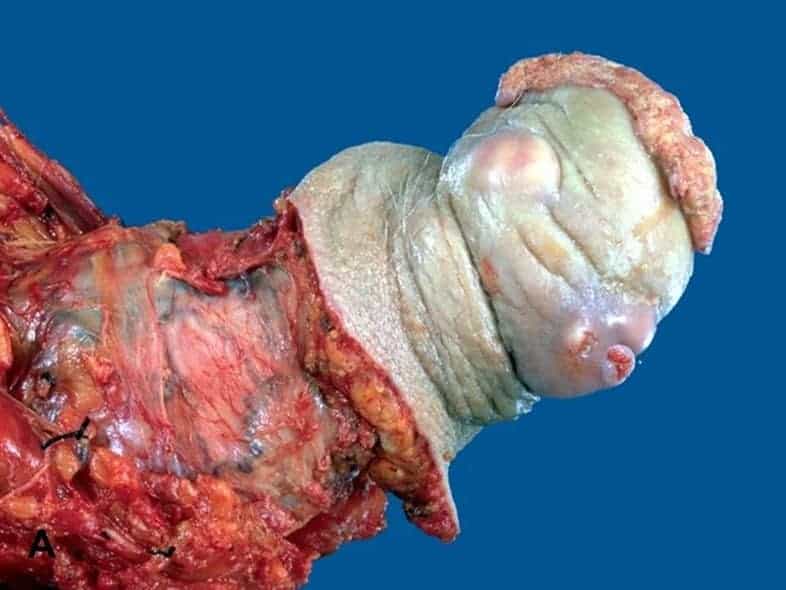
CARCINOMA OF PENIS
CARCINOMA OF PENIS
- MC type – SCC
ETIOLOGY-
- Premalignant lesions-
- Genital warts- Bushke- Lowenstein tumour is a giant penile condyloma (verrucous carcinoma of penis)
- Erythroplasia of Queyrat or Paget’s disease of penis- precancerous lesion
- Leukoplakia of glans
- Bowen’s disease- small eczematous plaque
- Chronic balanoposthitis, phimosis (50%), Balanitis xerotica obliterans
- Condyloma auminata (HPV)
- Most important carcinogens- HPV (16, 18, 31, 33)
- Poor hygiene
PATHOLOGY-
- Infiltrating type- pre-existing leukoplakia
- Papilliferous type
- Ulcerative type- glans penis MC site. 80% are low grade tumours
SPREAD-
- Lymphatics-
- Spreads to horizontal group of inguinal lymph nodes and are nodular, hard, fixed which suggests metstasis.
- Carcinoma from shaft of penis spreads to external iliac LN
- Initernal and paraaortic LN get enlarged
2. Blood spread is rare
3. Death may occur due to erosions of femoral vessels by iguinal LN.
CLINICAL FEATURES-
- Occurs in 6th decade
- Neonatal circumcision helps in immunity against carcinoma penis, HIV or STD.
- MC orginates from glans > sulcus > prepuce > shaft
- Foul smelling discharge is common
- In adults, recent onset of phimosis
- Haematuria, pain while passing urine- advanced tumours
- On examination, fungation and induration, everted edge
- Pain, oedema, tenderness, redness present on infection
- Urethra is rarely involved as it is protected by tough Buck’s fascia

INVESTIGATIONS-
- Incisional biopsy for grade and depth of invasion and wedge biopsy for SCC
- Senitel LN biopsy (Cabana sentinel LN)
- USG- assessment of depth
- MRI- IOC for staging in CA penis
STAGING-
- Stage 1- Confined to glans or prepuce
- Stage 2- involving penile shaft or copora cavernosa
- Stage 3- Operable inguinal LN metastasis
- Stage 4- inoperable inguinal LN metastasis Or advanced spread
TNM STAGING

TREATMENT-
- Surgery is the TOC
- Ca in situ- topical 5- FU cream, Nd- YAG laser, radiotherapy + follow up
- Ca in situ
- Young’s operation- for glans involvement without extending into proximal part of shaft
- Total amputation with perineal urethrostomy- if shaft is involved
- Piersey Gold operation- total amputation + total scrotectomy + total orchidectomy
- Laser ablation- stage T1 tumour
- Enlarged inguinal node- block dissection
Exam Important
- MC type – SCC
ETIOLOGY-
- Premalignant lesions-
- Genital warts- Bushke- Lowenstein tumour is a giant penile condyloma (verrucous carcinoma of penis)
- Erythroplasia of Queyrat or Paget’s disease of penis- precancerous lesion
- Leukoplakia of glans
- Bowen’s disease- small eczematous plaque
- Chronic balanoposthitis, phimosis (50%), Balanitis xerotica obliterans
- Condyloma auminata (HPV)
- Most important carcinogens- HPV (16, 18, 31, 33)
- Poor hygiene
SPREAD-
1. Lymphatics-
- Spreads to horizontal group of inguinal lymph nodes and are nodular, hard, fixed which suggests metstasis.
- Carcinoma from shaft of penis spreads to external iliac LN
- Initernal and paraaortic LN get enlarged
2. Blood spread is rare
3. Death may occur due to erosions of femoral vessels by iguinal LN.
CLINICAL FEATURES-
- Occurs in 6th decade
- Neonatal circumcision helps in immunity against carcinoma penis, HIV or STD.
- MC orginates from glans > sulcus > prepuce > shaft
- Foul smelling discharge is common
- In adults, recent onset of phimosis
- Haematuria, pain while passing urine- advanced tumours
- On examination, fungation and induration, everted edge
- Pain, oedema, tenderness, redness present on infection
- Urethra is rarely involved as it is protected by tough Buck’s fascia
TREATMENT-
- Surgery is the TOC
- Ca in situ- topical 5- FU cream, Nd- YAG laser, radiotherapy + follow up
- Ca in situ
- Young’s operation- for glans involvement without extending into proximal part of shaft
- Total amputation with perineal urethrostomy- if shaft is involved
- Piersey Gold operation- total amputation + total scrotectomy + total orchidectomy
- Laser ablation- stage T1 tumour
- Enlarged inguinal node- block dissection
Don’t Forget to Solve all the previous Year Question asked on CARCINOMA OF PENIS

