


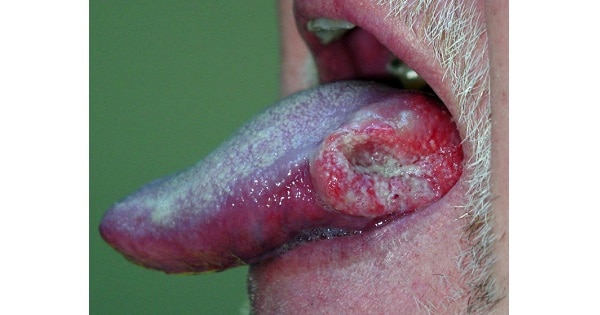
Carcinoma of Tongue
TONGUE CARCINOMA
- The tongue is the most common intraoral site of cancer in most countries.
- The disease affects males more frequently than females, with a male-to-female ratio of 2:1.
Etiology:
- Tobacco,
- Alcohol,
- Other factors: Areca catechu tree,the betel nuts or quid as well as the use of slaked lime
- Detection of mutations in tumor suppressor genes TP53.
Pathophysiology
- More than 90% of oral cavity cancers are squamous cell carcinomas. Most of the other lesions are of minor salivary gland origin. Lymphomas, melanomas, and sarcomas rarely occur in the tongue.
- Squamous cell carcinoma is by far the most common malignancy of the tongue, typically having 3 gross morphologic growth patterns: exophytic, ulcerative, and infiltrative. The infiltrative and ulcerative types are observed most commonly on the tongue.
- Lateral border being the most common subsite of origin.
Premalignant lesions
- Leukoplakia and erythroplakia
Clinical Presentation
- Weight loss, dysphagia and odynophagia, referred otalgia, hemoptysis, neck mass, hoarseness, and articulation difficulties
- Most common site of carcinoma tongue is middle of lateral border or the ventral aspect of the tongue followed by tip and dorsum.
- In carcinoma base of tongue pain is referred to the ipsilateral ear because of the common nerve supply of the base of tongue and ear i.e. Glossopharyngeal nerve.
- Incidence of cervical lymphnode metastasis Posterior tongue —> 70%
Classification of stage of tumor of oral cavity based on size of lymph node
- N0: There is no evidence of regional metastasis
- N1: Metastasis occur to a single ipsilateral lymph node, 3 cm or less in greatest dimension
- N2a: Metastasis in single ipsilateral lymph node, >3 cm and
- N2b: Metastasis occur in multiple ipsilateral lymph nodes, all nodes
- N2c: Metastasis occur in bilateral or contralateral lymph nodes, all nodes
Treatment
- Treatment of oral tongue cancer is primarily surgical, with wide local excision and negative margin control.
- Small tumors (T1- T2)- may be removed by wide local excision and primary closure or closure by secondary intention.
- Excision of larger tumors – requires partial glossectomy or hemiglossectomy.
- Schwartz writes- “The CO2 laser may be used for excision of early tongue cancers or for ablation of premalignant lesions.”
- If regional lymphnodes are involved- Modified radical neck dissection or selective neck dissection is done.
- Indications for postoperative radiation therapy include evidence of perineural or angiolymphatic spread or positive nodal disease.
- T1 stage (< 2cm in size): Insterstitial irradiation or excision (partial glossectomy).
- T2 stage (> 2 cm) in size: External beam radiotherapy or hemiglossectomy
Exam Question
- patient has carcinoma of right tongue on its lateral border of anterior 2/3rd, with lymph node of size 4 cm in level 3 on left side of the neck, stage of disease is N2.
- In carcinoma base of tongue pain is refered to the ear through Glossopharyngeal nerve.
- A patient with carcinoma of tongue is found to have lymph nodes in the lower neck. The treatment of choice for the lymph nodes is Radical neck dissection.
- Radiotherapy is used for which stage-I cancer -Anterior 2/3rd of Tongue.
- A patient presented with a 1 x 1.5 cms growth on the lateral border of the tongue. The treatment indicated would be Laser ablation.
- Carcinomatous ulcers are painless but may become painful in advanced stages, with extension into surrounding tissues.
- Commonest site of carcinoma tongue is Anterior 2/3 of Lateral borders
- Carcinoma tongue less than 2 cm is treated by Excision
- Tobacco chewing is a risk factor for Tongue Carcinoma.
- Lymph node invovlement occurs in case of Tongue Carcinoma.
- 60 year old man presents with an ulcer on lateral margin of tongue also complains of ear pain, most probable diagnosis is Carcinomatous Ulcer.
- Tongue carcinoma is usually Radio-sensitive.
- Posterior tongue most commonly metastasizes to cervical lymph nodes.
- Referred pain in the ear is commonly from Carcinoma of Tongue.
- Most common histological type of carcinoma of tongue is Squamous cell carcinoma.
Don’t Forget to Solve all the previous Year Question asked on Carcinoma of Tongue