
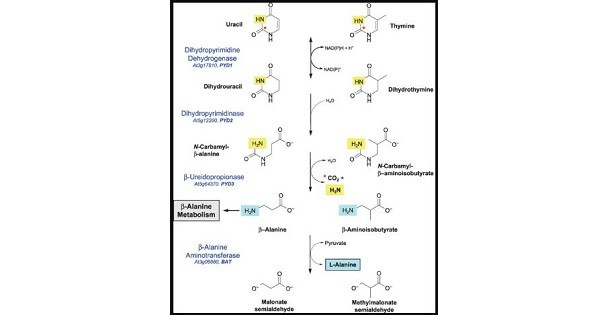
Catabolism of pyrimidine
introduction:
- Cytosine and Uracil to Beta Alanine Co2, NH3. Thymine to b-aminoisobutyrate Co2, NH3
- Unlike the end products of purine catabolism, the end products of pyrimidine catabolism are the highly water soluble.Hence, pyrimidine overproduction results in few clinical signs or symptoms.
- Pseudouridine is excreted unchanged as it cannot be catabolized in human.
Step 1:
- CMP, UMP and deoxyIMP is converted into Cytidine, Uridine deoxythymidine.
- This reaction is catalyzed by the enzyme Nucleotidase.
Step 2:
- Cytidine is deaminated into Uridine. This reaction is catalyzed by “Cytidine deaminase”.
Step 3:
- Uridine and deoxy thymidine (in case of DNA) is converted into Uracine and Thymidine.
- This reaction is catalyzed by Uridine phosphorylase.
- Here on inorganic phosphate is substituted on the first carbon of hydrolyzed Glycosidic linkage sugar molecule.
- The sugar molecule is released as in the form of Ribose-1-Phosphate and deoxy Ribose-1-Phosphate.

Step 4:
- Uracil and thymine is converted into dihydroUracil and dihydroThymine.
- This reaction is catalyzed into DihydroUracil and dihydroThymine.
- This reaction is catalyzed by dihydro uracil dehydrogenase.
- In this reaction one NADPH + H+ is oxidized into NADP+.
Step 5:
- DihydroUracil and dihydroThymine is converted into β-Urido Propionate and β-urido isobutyrate.
- This reaction is catalyzed by hydropyrimidine hydratase.
- In this reaction the cyclized molecule is converted into linear by cleaving the covalent bond at particular place.
Step 6:
- β-Urido propionate and β-urido isobutyrate is converted into β-alanine and β-amino isobutyrate.
- This reaction is catalyzed by β-Urido Propionase.
- The secondary products of this reaction are Ammonium ion (NH4+) and Carbon dioxide.
Step 7:
- The β-alanine and β-amino Isobutyrate is converted into Malonic semialdehyde and Methyl malonic semialdehyde by transamination process.
- This reaction is catalyzed by amino transferase and secondary substrate is α-ketoglutarate and secondary product is Glutamine.
Step 8:
- Malonic semialdehyde and methyl malonic semialdehyde is converted into Malonyl~coA.
- These two products are entering in the part of Fatty acid catabolism like methyl malonyl Patheway.
Conclusion:
- The Pyrimidine catabolism pathway generally lead to NH4+ production and thus to urea synthesis. Thymine for example, is degraded to Methylmalonyl semialdehyde, an intermediate of Valine catabolism. It is further degraded through Propionyl~coA and Methylmalonyl~coA to Succinyl~coA.
Exam Important
- Pseudouridine is excreted unchanged as it cannot be catabolized in human.
- The secondary products of this reaction are Ammonium ion (NH4+) and Carbon dioxide.
- The Pyrimidine catabolism pathway generally lead to NH4+ production and thus to urea synthesis.
- Thymine is degraded to Methylmalonyl semialdehyde, an intermediate of Valine catabolism.
- It is further degraded through Propionyl~coA and Methylmalonyl~coA to Succinyl~coA.
Don’t Forget to Solve all the previous Year Question asked on Catabolism of pyrimidine

