


Citric Acid Cycle
CITRIC ACID CYCLE/KREBS CYCLE/TRICARBOXYLIC ACID (TCA Cycle)
- The Citric acid cycle is the most important metabolic pathway for the energy supply to the body in which 65-70% of ATP is synthesized.
- Citric acid cycle involves final common pathway of the oxidation of acetyl CoA to CO2 & H2O from carbohydrates, fatty acids and amino acids.
- The site of occurance of TCA cycle enzymes is mitochondrial matrix except for succinate dehydrogenase found in inner mitochondrial membrane.
- The cycle operates in aerobic conditions.
Reactions of Critric acid cycle-
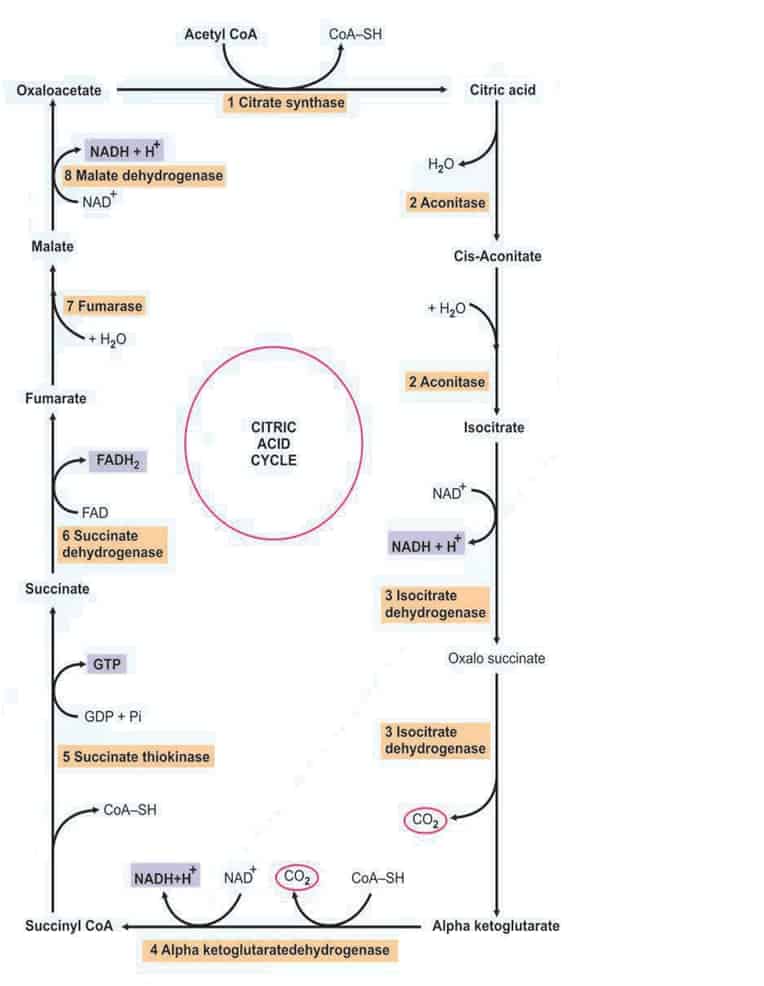
- Step 1- The 4 carbon, oxaloacetate condenses with 2 carbon, acetyl CoA to form 6 carbon compound, a tricarboxylic acid by enzyme citrate synthase. (irreversible step)
- Step 2- Citrate is isomerized to isocitrate by the enzyme aconitase.
- Step 3- The enzyme isocitrate dehydrogenase catalyses the conversion of isocitrate to oxalosuccinate and then to α-ketoglutarate. (irreversible step & NADH is formed)
- Step 4- Conversion of α-ketoglutarate to succinyl CoA catalyzed by α-ketoglutarate dehydrogenase. (NADH formed)
- Step 5- Succinyl CoA is converted to succinate by enzyme Succinate thiokinase. This is substrate level phosphorylation
- GTP is converted to ATP by enzyme nucleoside diphosphate kinase.
- Step 6- Succinate is oxidized by succinate dehydrogenase to fumarate.(FADH2 formed)
- Step 7- Fumate is converted to malate by enzyme fumarase.
- Step 8- Malate is oxidised to oxaloacetate by malate dehydrogenase. (NADH formed)
Inhibitors of Krebs Cycle-
| Enzyme | Inhibitor |
| Aconitase | Fluoroacetate |
| α-ketoglutarate dehydrogenase | Arsenite |
| Succinate dehydrogenase | Malonate |
- 12 ATPs are produced from one acetyl CoA.
- Krebs cycle is both catabolic and anabolic in nature so called amphibolic.
- Anaplerotic reactions are “filling up” reactions or “influx” reactions or replenishing reactions which supply 4 carbon units to the TCA cycle.
- ATP, NADH, acetyl CoA & succinyl CoA acts as an allosteric inhibitor to citrate synthase.
- ATP and NADH inhibit isocitrate dehydrogenase and activated by ADP.
- Alpha ketoglutarate dehydrogenase is inhibited by succinyl CoA and NADH.
- TCA cycle is involved in gluconeogenesis, transamination, deamination.
- Vitamins play a key role in TCA cycle-
- Riboflavin
- Niacin
- Thiamine
- Pantothenic acid

Exam Important
- There is no net generation oxaloacetate or cycle intermittents.
- First product of the cycle is citrate.
- Two irreversible steps are-
- oxaloacetate to citrate catalyzed by citrate (synthase)
- alpha ketoglutarate to succinyl CoA.
- NADH is produced and CO2 is liberated.
- GTP is produced by substrate level phosphorylation by succinate thiokinase.
- 4 dehydrogenases are used in Kreb’s cycle.
- Isolucine, Methionine, Valine enter by conversion into succinyl CoA.
- Tyrosine, phenylalanine enter conversion into fumarate.
- Pyruvate Carboxylase reaction is the classical example of the anaplerotic reaction.
Don’t Forget to Solve all the previous Year Question asked on Citric Acid Cycle

